1. Introduction
1.1. The NFL Offseason's Other Annual Tradition
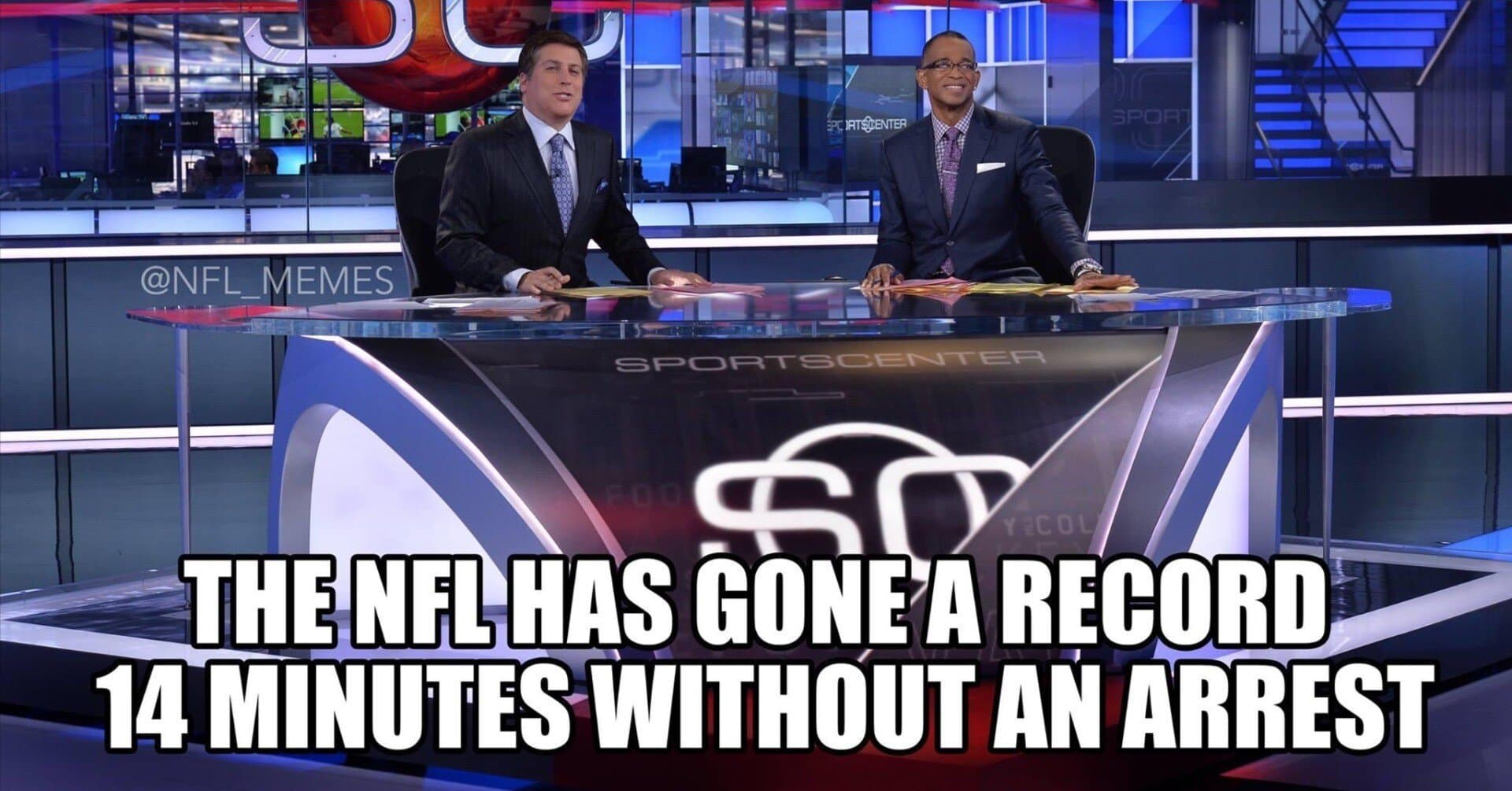
The biggest event of the offseason is the NFL Draft — but there's another recurring storyline that no serious fan can ignore: player arrests, misconduct, and the suspensions that follow. It's practically clockwork.
For Saints fans like me, the one that hit hardest recently was Alvin Kamara. Five straight Pro Bowls from his rookie year onward. One of the most electric backs in the league — effortless change of pace, impossible to bring down for his size, a legitimate weapon in the passing game. Never had a reputation for trouble off the field. Then, of all days, he gets arrested on Pro Bowl Sunday. The man who never gets caught on the field... got caught.
When a player gets arrested, the calculus is brutal: serious crime means an immediate release, lesser charges can still trigger a suspension — either way, your roster takes a hit you didn't plan for. The Kareem Hunt situation in 2018 is the textbook example. Video of him assaulting a woman surfaced, and the Chiefs cut him in late November. By then he had been one of the best backs in football, and I'll always wonder what difference it might have made in that AFCC loss to the Patriots in overtime. Can't change it now.
The point is: keeping your players out of legal trouble isn't just about optics — it's a roster management issue, a cap issue, and ultimately a Super Bowl contention issue.
1.2. Are Some Teams Just Worse at Managing This?
The arrest numbers across teams are not uniform — not even close. According to NFLArrest.com, since 2000, the highest total belongs to the Vikings and Broncos at 55 apiece (and Jeudy's incident isn't even in the database yet), while the Texans sit at the bottom with just 16.
Some of that gap is explainable — home market crime rates, a handful of players who ran up huge personal numbers (Adam Jones, the cornerback who played for the Bengals and Titans, was arrested ten times in his career). But plenty of fans have a more pointed question: "Is our team just badly run? Is there something about the organization's culture that's producing this?" As a Saints fan, I've asked myself that question more than once.
2. The Paper
Which brings us to a 2020 study that tackled a specific version of that question head-on:
"Does the gender and racial diversity of a team's front office influence the off-field arrest rate of its players?"
The researchers examined twelve years of data — every NFL team, 2003 through 2014 — tracking off-duty arrests per team per year against the demographic composition of each team's front office (share of women, share of racial minorities in executive roles).
The authors also put together a companion website summarizing the findings.
3. What They Found
3.1. Having Two or More Women in the Executive Suite Has a Significant Effect
The headline finding: when two or more women hold executive-level positions in an NFL organization, the number of player arrests drops by 21% in that year. On top of that, the probability of any arrest occurring drops by 15%.
That's not a marginal effect. That's a meaningful, statistically significant result.
3.2. Racial Minority Representation: No Clear Signal
The flip side: increasing the share of racial minorities in team leadership did not show a corresponding reduction in arrest rates.
The authors are careful here, and rightly so — they note that this result may be specific to the NFL's unusual demographics. When 68% of your players are Black, increasing "racial minority" representation in the front office means something fundamentally different than it would in most other industries. The study may be incomplete on this point.
(Personally, I think that's fair. The dynamic of adding women — an attribute with zero representation among players — is structurally different from adding racial minorities in a league that is majority Black. And this study only looked at arrests; racial diversity could be producing other positive effects that weren't captured here.)
 NFL player demographics — via The Atlas
3.3. It's About Numbers, Not Seniority
One important clarification: the researchers also tested whether the power held by female executives mattered — using management theory to weight influence by job title. It didn't move the needle. What drives the effect is simply having two or more women in the room, regardless of where they sit in the org chart.
4. Digging Into the Details (Feel Free to Skip)
4.1. Why Only Off-the-Clock Arrests?
The paper is fundamentally a management study — it's asking how organizational structure shapes employee behavior. On-field misconduct (PEDs, fighting during games) is more directly tied to coaches and on-field staff, so those were excluded to isolate the front office effect.
4.2. What About Confounding Factors?
The authors controlled for a long list of variables: year, geographic region, team payroll, franchise age, front office tenure, win-loss record, stadium reputation, and fan evaluations of team management and coaching — the last two pulled from ESPN survey data. The core finding holds up across all of these controls. "Two-plus women in the C-suite reduces arrests" is not explained away by any of the usual suspects.
4.3. Why the Threshold of Two?
This is rooted in a concept called Critical Mass — the idea that a subgroup needs to reach a certain number (not necessarily a majority) before its presence starts to meaningfully shape group dynamics. One person tends to be marginalized or overlooked. At two or more, the dynamic shifts. The researchers found that going from two to three didn't produce the same jump as going from one to two — the critical threshold is two.
4.4. What About Wrongful Arrests?
Fair point, and the authors acknowledge it. But they also note the inverse problem: illegal conduct that never leads to an arrest. Since a perfect accounting of player misconduct is impossible, arrest records are the best available proxy — imperfect, but workable.
4.5. Does the Type of Crime Matter?
The researchers wanted to break it down by offense type (crimes that might plausibly be influenced by organizational culture vs. those that wouldn't), but the dataset got too thin once you start slicing that finely. Something for future work.
4.6. Isn't the NFL's Arrest Rate Just Really High to Begin With?
Here's a stat that might surprise you: NFL players are actually arrested at a lower rate than the general American male population of the same age. There's a published paper on this.
4.7. Why Would Female Executives Lower Arrest Rates?
The authors' working hypothesis: women in leadership roles shift organizational culture, strategic priorities, and decision-making processes in ways that reduce off-field misconduct. They cite management and sociology research to support the theory, and they're planning follow-up work — interviews with NFL and NBA teams that have brought women into executive roles, plus more granular data like arrested player profiles — to get closer to a causal explanation.
5. Side Notes
5.1. The Paper Got Censored — and the Authors Were Not Happy
Here's a wrinkle: the finding in section 3.2 — "racial minority representation showed no correlation with arrest rates" — was pulled from the main body of the published paper by editorial request. It now lives in an appendix.
The authors wanted to include their full argument, including the NFL-specific context and why the null result might not generalize. The editor said no. By all accounts, the authors were not pleased about it, and at least one wrote about the situation on their personal website.
My read: the editors were probably worried that "adding racial minorities to your front office doesn't reduce arrests" would get clipped out of context and go viral in a way that completely misrepresents the study's scope and nuances. Given the current climate in American public discourse, that's not an unreasonable fear. But for the researchers who put in the work and wanted to tell a complete story — it's a genuinely frustrating outcome. A very American story.
5.2. The Authors Are NFL Fans, Too
Two professors from Syracuse University (Kinesiology / Sport Management) and one attorney who also holds an affiliation with Tulane University. All three are NFL fans:
- Professor Graham: Bills
- Assistant Professor Walia: Bengals
- Attorney Robinson: Eagles (former high school center himself; has also done salary cap work for the NBA's Brooklyn Nets)
I like to imagine the research breaks turning into NFL discussions. As someone in academia who would love that kind of overlap with fellow researchers — I get it.
5.3. Why This Research Matters Beyond the NFL (My Take)
The gender diversity debate is everywhere right now — in Japan, in corporate boardrooms, in academia. The problem is that these conversations often stall out around fairness arguments: "The current female representation is unacceptable" gets met with "That's a legacy problem, not our fault" or "You're discriminating against men." The framing stays stuck on negative correction rather than positive upside.
And that's exactly why this study is genuinely interesting beyond the football context. It doesn't just say gender diversity is fair or equitable — it says gender diversity produces a measurable, concrete, hard-to-argue-with positive outcome: a 20% drop in employee arrest rates.
"Diversity drives innovation" is abstract. "A female perspective is valuable" is debatable. "Diversity reduces your employee arrest rate by 20%" is the kind of number that lands differently. If the goal is to actually move organizations, accumulating this kind of specific, well-evidenced data matters.
6. Takeaways
Long article for a somewhat sensitive topic — the TL;DR from the research: put at least two women in your executive suite and your players' off-field arrest rate drops significantly, around 20%. The effect is statistically robust and holds up after controlling for a wide range of other factors.
As a Saints fan, I'll note that New Orleans has had quite a few arrests lately (3 in the past year, 30 total since 2000) — despite having a female owner in Gayle Benson. Though given that she personally flew out to meet Deshaun Watson despite everything, maybe that's a case study for a different paper.
On-field analytics papers are great, but off-field research like this is its own kind of fascinating. I've also read studies on "Does crime actually go up on NFL game days?" and "Do Super Bowl host cities see real economic gains?" — those might be worth breaking down next time.
If there's something specific you'd like me to cover, reach out on X, DMs, or the question box. Always open to suggestions.