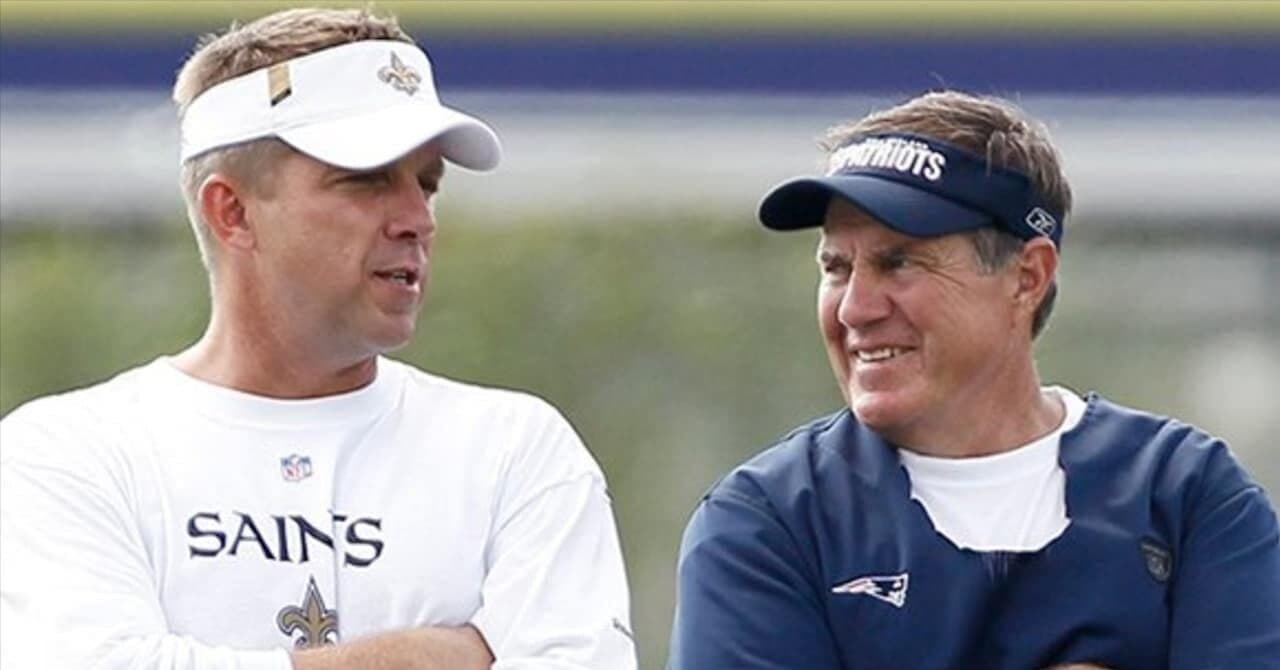
I'd been sitting on this piece for about a month, planning to publish it once the Saints' playoff hopes officially died — but the Saints went on a bizarre three-game winning streak, and the NFC South kept being the NFC South, so here we are at the regular season finale.
With Denver reportedly requesting an interview, let's dig into something genuinely rare in the modern NFL: the head coach trade — how it works, what the rules are, and what history tells us about the price tag.
1. Why Does a "Retired" Coach Need to Be Traded?
If you're a Saints fan, you owe a lot to Sean Payton — 16 years (2006–2021) as head coach, one Super Bowl ring, and the transformation of New Orleans from a franchise nobody feared into a consistent contender alongside Drew Brees.
Payton stepped away in January, citing burnout — and honestly, having to start Trevor Siemian and Ian Book a combined five times during a playoff push would wear anyone down. But his stint in the broadcast booth clearly isn't scratching the itch. By Week 2 of the season, he was already putting out vibes that he wanted back in. Denver firing Nathaniel Hackett only turned up the heat.
Payton's parting remarks made it sound like a return to New Orleans was off the table — though there was reporting suggesting otherwise — and the Broncos have since formally requested an interview, which the Saints have approved.
Which raises a question you've probably seen on social media: if Payton retired, why does he need to be traded at all?
"Can teams even trade coaches?" "Isn't that against the rules?"
These questions are popping up constantly right now — and honestly, it makes sense that people are confused. Coach trades are rare enough that the rules aren't widely understood. So let's walk through it.
2. Head Coach Contracts Are Fully Guaranteed
The single biggest difference between a head coach's contract and a player's contract: coach salaries are fully guaranteed from day one.
With players, a "5-year, $100M deal" doesn't mean $100M is actually owed — non-guaranteed money on the back end can be voided when the team cuts a player. Not so for head coaches. Cut a coach mid-contract, and you still owe him every dollar remaining on that deal (barring criminal misconduct or specific clause violations). This is why you never hear about a team cutting a head coach for financial reasons.
The headlines this year about Carolina still paying Matt Rhule after firing him, or the Raiders reportedly being unable to fire Josh McDaniels because they couldn't afford to hire a replacement? That's exactly this dynamic at work.
(Side note: Rhule pivoted immediately to a college HC role, so the Panthers will reportedly be credited with his college salary against their remaining obligation — a rare bit of cap relief.)
There's also no salary cap equivalent for coaching salaries, which means pay doesn't necessarily track with performance. Plenty of head coaches don't even have their salaries made public.
3. How Is a Coach Trade Different From a Player Trade?
When a coach is fired outright, he becomes a free agent immediately. But Payton resigned — he wasn't fired. That distinction matters enormously. Under NFL anti-tampering rules, the Saints retain the rights to Payton through 2024, the end of his original contract. If any other team wants to employ him during that window, they need the Saints to formally release him from that contract first.
The Saints have zero incentive to just let him walk for nothing. So the mechanism is: the new team offers the Saints something of value in exchange for releasing Payton — draft picks, compensation money — and that is what we call a head coach trade.
 The NFL's anti-tampering rule language — the foundation for why coach trades work this way
(The logic behind this rule: if resigned coaches became instant free agents, other teams could quietly pressure a coach into retiring just to poach him — a form of tampering that would be nearly impossible to detect or enforce.)
There are two important ways these trades differ from player trades:
Rule 1. No Players in the Trade (This Is a Big One)
The compensation in a head coach trade can only be draft picks or cash — no players. A straight pick swap (e.g., New Orleans' 2nd for the acquiring team's 1st) is fine. Sending an actual roster player as part of the deal is not allowed.
This rule is surprisingly underknown. Every coaching hire cycle surfaces tweets like this proposing Patrick Surtain II or some other star player as trade compensation — which is simply not a legal structure. If you want Payton, the ask from Saints fans should be something like: "Can we have that 2023 1st you got in the Bradley Chubb deal?" Not a player.
Rule 2. The Existing Contract Doesn't Transfer
In a player trade, the remaining contract — salary, years, structure — moves to the new team. In a coach trade, the old contract is terminated, and the new team negotiates a brand-new deal. This favors deep-pocketed ownership groups, though it also gives both sides flexibility.
4. What's the Going Rate? A History of Traded Head Coaches
So how much should you expect to pay? The Saints have reportedly asked for a first-round pick. Is that realistic?
Let's look at every head coach who has been traded for draft compensation in NFL history — five cases total.
1. Jon Gruden (OAK → TB, 2002)
 Jon Gruden during his time in Oakland
The gold standard. Gruden built Oakland into a winner over four seasons (the same Gruden who was later fired from Las Vegas amid an email scandal), posting back-to-back division titles before owner Al Davis decided not to extend him — and instead shipped him to Tampa Bay.
The price: two first-round picks (2002, 2003) + a 2004 second-round pick + $8M in cash. The most expensive coach trade in NFL history.
What made it legendary: the very next season's Super Bowl was OAK vs. TB. Gruden's Buccaneers beat his old Raiders team, and the game has been called the "Gruden Bowl" ever since. Oakland, meanwhile, entered a 13-year stretch of losing records. Tampa Bay got its Lombardi — but the draft capital they surrendered eventually caught up with them too, and Gruden was fired after 2008.
The Raiders came full circle: after new ownership took over, they brought Gruden back in 2018 on a 10-year, $100M deal with a no-trade clause — only to cut him in 2021 over that email scandal.
(OAK: 38–26 in 4 years | TB: 57–55 in 7 years)
2. Mike Holmgren (GB → SEA, 1999)
 Mike Holmgren — he and Andy Reid have the same energy
Another success story. After turning San Francisco's offense around as OC, Holmgren went to Green Bay and built one of the great coaching runs in modern NFL history — 75–37 over seven seasons, three division titles, two Super Bowl appearances, one championship. He developed both Steve Young and Brett Favre.
Seattle came calling with a massive offer ($4M/year × 8 years, with VP and GM authority), and the trade to release him from his Packers contract cost them a 2nd-round pick. Holmgren spent a decade in Seattle and took the franchise to its first-ever Super Bowl in 2005.
(GB: 75–37 in 7 years | SEA: 86–74 in 10 years)
3. Bill Parcells (NE → NYJ, 1997)
 Bill Parcells
This one is genuinely strange — and directly connected to the Belichick case below.
Parcells turned a struggling New England program into a Super Bowl contender, going 32–32 over four years including an AFC Championship run. But his relationship with owner Robert Kraft deteriorated over control — Parcells wanted full GM authority, Kraft wasn't giving it. New York came calling with exactly that offer.
Problem: Parcells was still under contract. So the Jets tried an audacious workaround — they hired Bill Belichick as their official head coach, then brought Parcells in as an "advisor." Translation: Parcells ran the team. New England sued. Commissioner Paul Tagliabue stepped in, and the resolution was three picks moving from NYJ to NE: a 4th (1997), a 2nd (1998), and a 1st (1999).
Parcells went on to take that Jets team from 1–15 to 9–7 in year one, then 12–4 before losing the AFCC. He's the only head coach in the Jets' history to have a winning record over two or more seasons.
(NE: 32–32 in 4 years | NYJ: 29–19 in 3 years)
4. Bill Belichick (NYJ → NE, 2000)
 Bill Belichick — yes, he has smiled before
After Parcells retired, Belichick was slated to take over as the Jets' head coach for the 2000 season. Then, one day after his appointment was announced, he showed up to the press conference and resigned — famously on a napkin: "I resign as HC of the NYJ."
The Jets accused New England of tampering. Belichick claimed breach of contract and unstable ownership. Tagliabue mediated again. The settlement: NYJ sent NE a 1st (2000), a 4th (2001), and a 7th (2001). NE sent NYJ a 5th (2001) and a 7th (2002).
What happened next in New England doesn't need a recap. Six Super Bowl titles. The greatest dynasty in the salary cap era.
(NYJ: technically 0 days | NE: 262–107 through Week 17 of 2022)
5. Herm Edwards (NYJ → KC, 2006)
 Herm Edwards
And now the cautionary tale.
Edwards, coaching New York, used Kansas City's reported interest in him as leverage to negotiate a contract extension and raise with the Jets. It didn't work — the Jets apparently didn't value him that highly. (His team had just gone 4–12, so... fair enough.)
The Jets then flipped the script entirely. If KC wanted Edwards, they'd trade him — and they did, for a 4th-round pick. An underwhelming return for a sitting head coach, but fitting given the circumstances.
(NYJ: 39–41 in 5 years | KC: 15–33 in 3 years)
5. What Does All This Mean for Payton?
Summarizing the historical comp data:
The history says a first-round pick — or something in that range — is realistic for a coach of Payton's caliber. The Saints asking for one isn't unreasonable.
That said, this situation is genuinely unusual. None of the prior cases involved a coach who simply retired on his own terms, with no blowup with ownership, and no team that came in waving a massive contract. There's no perfect precedent here. Analysts with GM experience are all over the map on what fair compensation looks like, and the 2000-era comps involve a very different first-round pick value given changes to the rookie wage scale.
As a Saints fan, I'd love to see a bidding war drive the price up. But unlike a player trade, both sides have to actually want the deal — Payton has to want to go, and the acquiree has to want him enough to pay. If the price ends up lower than we hoped, that's the structure of the situation, not the front office failing. And honestly, watching Gruden's post-trade arc in Tampa Bay, maybe a team that gives up multiple first-rounders will end up hurting themselves anyway.
Either way, a head coach trade hasn't happened in years. Depending on what the final terms look like, we might be about to set a new precedent — and potentially trigger a wave of similar moves like we saw around 2000.
(Update, January 31) It's done. The final trade: New Orleans receives the 2023 1st-round pick (29th overall, originally via San Francisco), and the two sides swap 2024 2nd and 3rd-round picks (Denver's 2nd for New Orleans' 3rd). A first-round pick, just as predicted. Now the question is whether Payton can do for Russell Wilson — another undersized QB who struggled badly adjusting to a new team last year — what he once did for Drew Brees.
6. Sources
- NFL: 5 coaches who were 'traded' — The Oregonian
- Q&A With Sean Payton: Coaching Rumors, What He's Looking For In His Next Job — Chris Rosvoglou, The SPUN
- Everything Sean Payton said at his 90-minute farewell press conference — Amie Just, nola.com
- Sean Payton will be a hot commodity — but what will it cost? — Jonathan Jones, CBS Sports
- 6 NFL Teams That Should Be Willing to Pay the Price to Get Sean Payton — Kristopher Knox, Bleacher Report