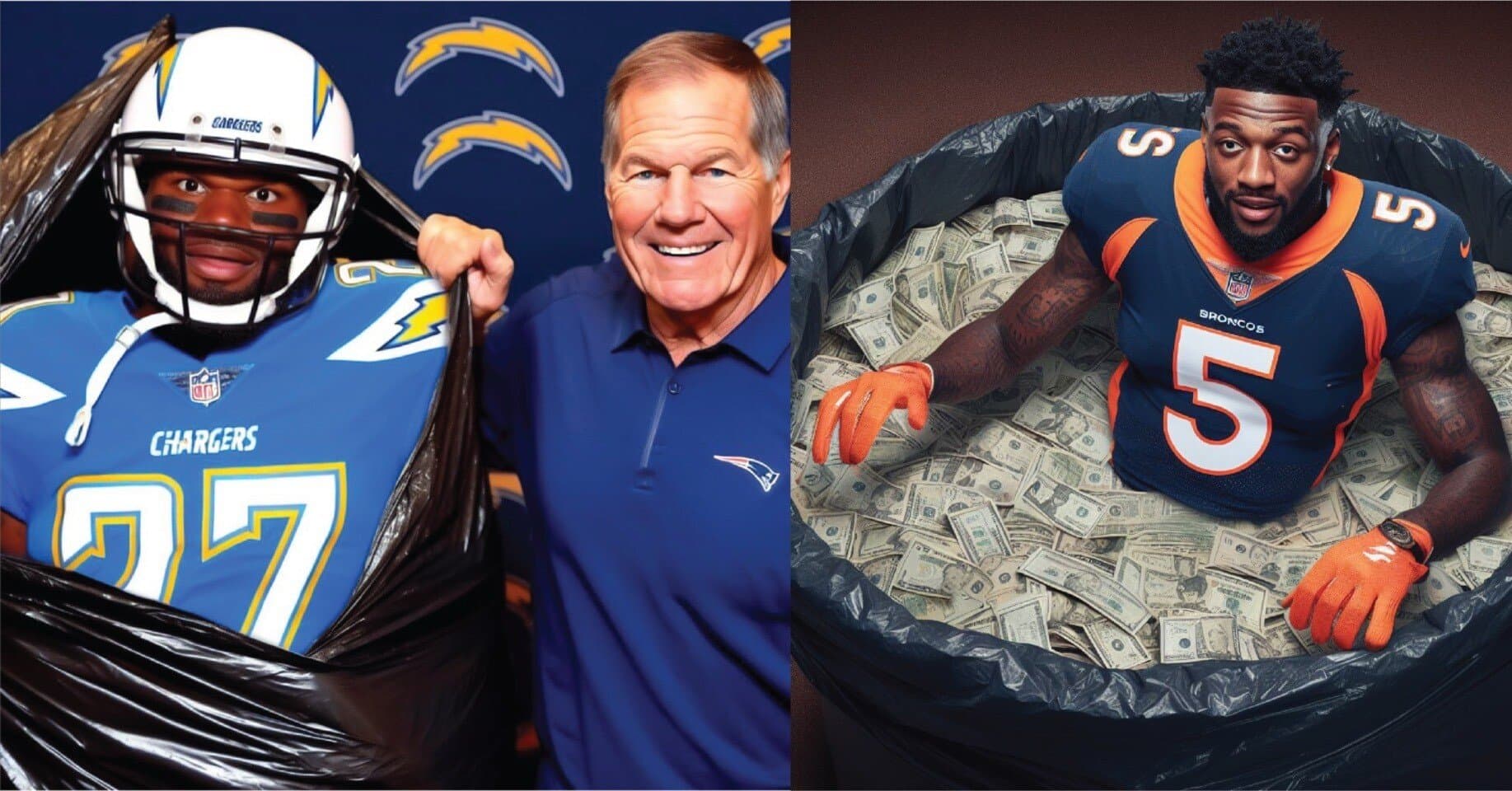
This week, two big moves hit the AFC East simultaneously: J.C. Jackson was traded from the Chargers to the Patriots, and Randy Gregory was released by the Broncos. Two players let go in year two of massive five-year free agent deals — on the same day — is unusual enough to warrant a closer look. It seemed like a perfect opportunity to dig into the salary cap mechanics behind these moves. Today's topic: dead money.
A quick note on scope: this site draws a pretty wide range of readers, from die-hard cap nerds to more casual fans, so I want to start from the basics — "what is dead money and how does it work?" — and build from there. Veterans of this stuff can feel free to skip ahead to section 1.2.
1. How Dead Money Works
1.1. The Two Building Blocks of an NFL Contract
Before we get to dead money, let's establish the foundation. NFL player salaries are generally built from two components, each with distinct payment timing and cap accounting rules:
- Base Salary:
- Paid: In 18 equal weekly installments during the regular season (technically split across 36 payments per collective bargaining rules, but the cap mechanics don't change)
- Cap hit: Counts fully against the cap in the year it's paid
- Signing Bonus:
- Paid: As a lump sum at the time of signing
- Cap hit: Spread across up to five years from the signing year
(Most modern contracts also include Roster Bonuses, Option Bonuses, and various incentive structures — but those aren't central to today's story, so we'll set them aside.)
1.2. J.C. Jackson's Deal: A Worked Example
J.C. Jackson's 2022 free agent signing with the Chargers:
Let's use Jackson's contract as our case study. When he signed with the Chargers in 2022, he agreed to a five-year, $82.5M deal. The structure broke down like this:
- Signing Bonus: $25.0M
- Base Salary: $3.0M (2022), $14.0M (2023), $14.4M (2024), $14.0M (2025), $14.1M (2026)
Focus on year one, 2022. The actual cash paid to Jackson coming out of the signing: the $25M signing bonus hits immediately, then $3M in base salary gets distributed weekly through the regular season — a total of $28M out the door in 2022.
But here's where cap accounting diverges from cash accounting. The Chargers' 2022 cap hit is not $28M. The signing bonus gets prorated across five years, so just $5M counts against the cap in 2022. Add the full $3M base salary for the year, and you get an $8M cap hit for 2022 — even though $28M in cash was actually paid.
In other words: the moment that contract was signed, $28M went out in cash while only $8M hit the cap — a $20M deferral built into the accounting. That $20M doesn't disappear; it gets recognized over the following four years. And the iron law of NFL cap accounting is that at the end of a contract, total cap hits must equal total cash paid. The books always balance, eventually.
Here's what five years of cap hits look like visualized:
Worth clarifying here: the "salary cap" is not a limit on how much total cash teams spend. It's a limit on the sum of all players' cap hits in a given year. In 2022, the cap was $208M — but as the tweet below illustrates, actual cash disbursed by each team varied considerably.
The gap between cap hits and actual cash paid across teams:
1.3. What Happens When You Cut a Contract Short?
Dead money is, at its core, a consequence of ending a contract early — via trade or release. When a contract is terminated mid-stream, two rules apply (with some exceptions):
- Rule 1: Money already paid stays paid. It still counts against the cap of the original team.
- Rule 2: Money not yet paid doesn't need to be paid. Once the player is gone, future base salary obligations disappear from the cap along with the player.
Back to our example. Jackson was traded from LAC to NE after Week 4 of the 2023 season. For the moment, let's assume it was a straight trade — no salary restructuring, no LAC absorbing additional costs.
At the point of the trade, LAC had already paid:
$32.7M = Signing Bonus ($25M) + 2022 Base Salary ($3.0M) + 2023 Weeks 1–4 Base Salary ($4.7M)
That's the total LAC is on the hook for — what they paid and what's already hit their cap. The remaining $49.8M ($82.5M − $32.7M) carries over to New England, and LAC is off the hook for it. Visualized:
The hatched portion represents what LAC has already paid and absorbed. The faded portion is what New England inherits — roughly four years and $49.8M left on the deal, which is now NE's problem (or opportunity) to manage.
1.4. Dead Money = The Deferred Signing Bonus Coming Due
Here's the issue. After that trade, Jackson no longer plays for the Chargers — but the prorated signing bonus still sits on their cap. For 2023 through 2026, his remaining cap charge lives on even though he's in New England. That stranded cap charge is what we call dead money.
There's an important nuance here: the five-year proration of a signing bonus only applies while the player is on the roster. Once a player is cut or traded, the remaining unpaid proration doesn't get to spread out on its own schedule anymore.
In Jackson's case, 2023 was already underway — so the $9.7M in prorated bonus for that year counts as dead money as-is. But 2024 through 2026 cannot continue to be spread at $5M/year. Instead, the full remaining $15M gets accelerated and hits the Chargers' 2024 cap all at once.
Future dead money doesn't spread — it accelerates. The entire remaining proration hits in a single year.
One adjacent point worth knowing: the "season has started" threshold that determines which year an acceleration lands in is June 1st each year. Cut a player before June 1st and the full remaining proration hits that same year. Cut after June 1st and you can split the dead money across two years (though the total amount doesn't change — it's timing, not volume). The Deandre Hopkins situation earlier this year was a clean example of the post-June 1 split.
1.5. Advanced Case: Restructuring to Facilitate a Trade
The actual Jackson trade was more complicated. Rather than a straight transfer, the Chargers agreed to absorb a portion of Jackson's remaining salary — similar to what Cleveland did for the Carolina Panthers in the Baker Mayfield trade the previous year.
Details of the Jackson trade terms:
Jackson's remaining base salary for Weeks 5 through 17 was $9.3M — which, in a straight trade, would have transferred entirely to New England. But New England apparently balked at absorbing that (and frankly, given the competition for Jackson's services, the Chargers probably didn't have much leverage to push back). So LAC pre-paid $7.7M of that $9.3M directly to Jackson up front, reducing the amount NE had to take on to just $1.6M.
Here's the twist: rather than charging that $7.7M as a lump sum to the 2023 cap, the Chargers converted it to a signing bonus equivalent, locking in the right to spread it across two years (since the full cash had already changed hands, it qualifies for the same proration treatment as a signing bonus).
This is the exact same mechanism as the contract restructure — the move Saints and other cap-strapped teams execute every February and March like clockwork. Converting base salary to treated-as-signing-bonus, paying it out immediately, and spreading the cap hit over future years. Same principle, different context.
After all of that, the final tally: $13.5M in dead money hitting in 2023, and $18.8M in 2024 — $32.3M total.
2. Why Trade or Cut Mid-Season Instead of Waiting Until the Offseason?
2.1. J.C. Jackson (LAC) — The Trade Case
The primary financial benefit of trading an unwanted player is avoiding future base salary payments. But with LAC absorbing $7.7M on Jackson's behalf, the amount they actually saved by trading rather than keeping him through the year was just the $1.6M NE took on. Since there was no guaranteed money left on the 2024+ portion of the deal anyway, the difference between "trade now" and "keep him through December and cut him in February" was only $1.6M from a pure cap standpoint.
Which means the case for the trade rested on everything else:
- Saving $1.6M in cap space
- Freeing a roster spot starting Week 5
- Draft capital (a 2025 6th/7th-round pick swap)
- Player relations and locker room dynamics
The fact that LAC decided those four combined benefits outweighed keeping Jackson for the rest of the season tells you something about how untenable that situation had become. Following the cap mechanics is often the best way to understand just how done a team is with a player.
Jackson's performance situation with the Chargers:
2.2. Randy Gregory (DEN) — The Release Case
The Gregory situation was arguably even more jarring. Like Jackson, Gregory was let go in the second year of a five-year, $70M deal signed in 2022. But unlike a trade, releasing a player means the original team must also cover any fully guaranteed base salary that hasn't been paid yet — that doesn't transfer to anyone. (In a trade, fully guaranteed money transfers to the new team along with the rest of the contract. For more on how guaranteed money works, see this explainer.)
Gregory's 2023 base salary was fully guaranteed. The Broncos had to pay it regardless. From a cap standpoint, cutting Gregory mid-season and cutting him after the season produced identical results — not even the $1.6M LAC saved on the Jackson deal. No draft capital, either.
So Denver's calculus came down to just two things:
- Freeing a roster spot starting Week 5
- Removing a disruptive presence from the locker room
Those factors alone were apparently enough — reports suggested Gregory had pushed for release after seeing his playing time reduced. The final dead money total: $16.1M in 2023, $6.3M in 2024 — $22.4M in total.
Gregory's release confirmed:
(10/6 Update) Turns out "release" was a bit premature — before the paperwork was official, the 49ers swooped in with a trade offer. Same Jackson playbook: the Broncos pre-paid Gregory's remaining salary and ate the bulk of it themselves, NE inherited a minimal obligation, and San Francisco picked up a cheap piece for the stretch run with zero dead money implications going forward if they eventually cut him.
Gregory's move to San Francisco:
3. Does High Dead Money Mean a Team Made a Mistake?
The Jackson trade left the Chargers with $32.3M in dead money — a legitimately large number (the all-time high is somewhere around $40M, held jointly by Matt Ryan and Aaron Rodgers, so this lands in the same conversation). Dead money has a bad reputation, and not without reason: unlike active player salaries, dead money can't be renegotiated, restructured, or moved. Too much of it, and it chews through cap space that could go toward current roster needs.
But the leap from "lots of dead money" to "bad decision" is a shortcut I'd push back on.
If LAC had kept Jackson through the end of 2023 before cutting him, the dead money total would have dropped to $15M. Hold through 2024 and it falls to $10M. On paper, that looks cleaner. But here's the accounting reality: every additional year Jackson stays, those dead money dollars would be paid as active base salary instead. The Chargers' total cash outlay to Jackson keeps growing the longer they wait — the only thing that changes is whether it's labeled "dead money" or "base salary."
If Jackson were playing well, paying that base salary would be fine. But from what was visible on the field this season — healthy scratches, minimal snap counts, no sign of the player who earned the contract — there was little basis for betting things would turn around. Cutting a sunk cost early, before paying even more into it, is sound financial logic even if the dead money number reads ugly.
The broader view: LAC paid Jackson a total of $40.3M across the life of this contract. A five-year, $82.5M deal ($16.5M/year average) was compressed into two years at $40.3M ($20.2M/year). Expensive, sure — a swing-and-a-miss by any measure — but not the franchise-altering catastrophe the raw dead money figure might suggest. When a player on my favorite team goes sideways on a big contract, I've taken to telling myself: just treat it like an injury.
Personally, I've never loved the term "dead money." It carries an implication of pure waste — and sometimes, dead money is pure waste (a player cut immediately after signing a new deal due to misconduct, for instance). But just as often, dead money is the deliberate cost of a correct decision made at the right time.
The strongest argument against the "high dead money = bad team" framing: the 2022 Eagles went to the Super Bowl with roughly $60M in dead money — about 30% of their entire cap. The difference isn't the amount. It's the quality of the decisions behind it.
There's good dead money and bad dead money. That's the take I'll stand by.