Back with another research breakdown. The last one — about half a year ago — covered what team front office diversity does to player arrest rates. This time, a related but different angle: what happens to general crime rates in a city on NFL game days?
You hear it every World Cup, every Olympics: "sports brings people together," "the whole country felt it." But is there actually a measurable social effect? Researchers took that question seriously and tested it using NFL data. Here's what they found.
1. No Games, More Crime? Ray Lewis Had a Theory
 Baltimore Ravens legend Ray Lewis
In a 2011 interview during the NFL lockout, Baltimore Ravens linebacker Ray Lewis made a comment that sounds like a throwaway line but turns out to be a testable hypothesis: "If we don't have a [NFL] season... watch how much crime picks up."
His logic: if people have nothing to watch, they have more time — and more restless energy — to get into trouble.
It's actually grounded in a real behavioral economics concept: crime substitution — the idea that when people are occupied with an engaging alternative activity, impulsive crimes decrease. The effect has been documented with video games, movies, and other entertainment. The question Lewis was implicitly raising: does watching the NFL work the same way?
2. The Paper: Testing It With Chicago Crime Data
Researchers at UC Davis decided to actually run that test. The result was published in Journal of Sports Economics in 2019.
3. What They Found
The focal team: the Chicago Bears. The dataset: Chicago Police Department incident reports from 2001 to 2013. The scope: every Bears game on Sunday or Monday, plus every Super Bowl — 200+ games total — and how crime reporting in Chicago shifted on those days compared to normal.
One distinguishing feature of this study: it wasn't limited to home games. The researchers specifically wanted to capture the TV-viewing effect, not just what happens near the stadium.
3.1. Crime Drops During Games
The headline finding: on Bears game days, crime reports in Chicago drop significantly. When you break the data down by hour, the pattern is striking — reports fall noticeably as kickoff approaches and stay low through the game. And importantly, this holds across crime types — it's not just one category pulling the average down.
 Bears MNF game-day crime report rate vs. baseline (source)
3.2. Higher-Rated Games, More Crime Suppression
Intuitive, but confirmed: the bigger the audience, the larger the crime reduction.
- Bears regular Sunday games: –3%
- Bears Monday Night Football appearances: –13%
- Super Bowl: –26%
 February Sunday baseline vs. Super Bowl Sunday. Hard to commit crimes when you're locked into the game. (source)
One wrinkle with the Super Bowl specifically: while crime drops sharply during the game, violent crime ticks up in the hours after. The authors' read: the Super Bowl is uniquely social — people gather in groups — and post-game crowds that have been drinking all day are a different animal than the typical Sunday night.
3.3. Wins Suppress Crime More Than Losses
The MNF data shows that when the Bears won, the crime reduction was more pronounced than when they lost (wins: –17%, losses: –6%). That tracks with the additional studies discussed below.
The authors — who are probably Bears fans, based on how they write about this — add a diplomatic caveat:
"The Bears were fairly successful on Monday nights in the last decade, so our sample size of games in which the Bears lost is only seven."
"The difference between winning and losing games may also be due in part to the fact that a good team will draw more viewers and is also more likely to win."
That's a fairly elaborate way to brag about your team's Monday night record in an academic paper. The sample includes multiple division title seasons. Asking for updated data seems fair.
 Crime probably went up that day
3.4. The Effect Extends to Other Chicago Sports
The researchers also ran the same analysis on other Chicago franchises: the Cubs, White Sox (MLB), and Bulls (NBA) during their playoff runs. The same pattern held — crime reports dropped during games, though the magnitude was smaller than for the NFL.
(Note: they used playoff data for baseball and basketball because regular-season viewership for those sports is too low to generate a meaningful signal.)
There was a surprise: the MLB World Series and NBA Finals didn't produce nearly as much suppression as expected (–2% and –3% respectively). The likely explanations: seasonality, and the fact that non-local fans are far less likely to watch those championship games than the Super Bowl, which is effectively a national event.
3.5. Conclusion: Ray Lewis Was Right
The authors argue the most defensible explanation for the crime reduction is exactly what Lewis intuited: people who might otherwise commit crimes are sitting on their couches watching football. Here's how they reason through the alternatives:
Theory 1: Potential victims stay home, reducing opportunity (victims are watching) → Doesn't explain why property crimes like burglaries drop — the victim's location is irrelevant there.
Theory 2: Crime isn't dropping — reporting is (the reporter is watching) → Doesn't explain why violent crimes, which almost always get reported, also drop. And if delayed reporting explains it, we'd expect a post-game spike in reports against this type of crime. That doesn't show up.
Theory 3: Police attention lapses during games (cops are watching) → Doesn't explain why crime drops across all types, regardless of police involvement in detection. For most crimes, it's the victim who reports — not police discovering the crime.
4. Wait — There Are Also Studies Showing NFL Games Increase Crime
The relationship between large sporting events and local crime is a well-studied area across economics, psychology, and criminology. Multiple research groups have approached it from different angles, and some of them find the opposite result. The important thing: these aren't necessarily contradictions. Let's look at three.
4.1. "Upset Losses Cause a Spike in Domestic Violence" (Card and Dahl, 2011)
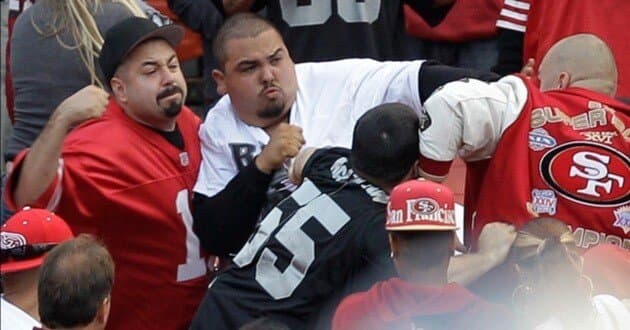
When a home team loses a game they were expected to win — an "upset loss" — domestic violence by male perpetrators against female partners increases by roughly 10%, according to this study. The mechanism isn't subtle: unexpected losses produce intense frustration, and that frustration sometimes turns violent at home.
To put it in recent context: during the 2022 World Cup, reports emerged of a German fan destroying his TV after Germany lost to Japan (might have been staged, but the point stands). Reports at the time said his family immediately moved to a hotel. Knowing this research, I didn't find that particularly funny. And genuinely — I've had Bears losses where I completely understood the impulse to break something.
 DV spike image following upset losses
4.2. "NFL Game Days See More Property Crime — But Playoffs Are Different" (Kalist and Lee, 2014)
Looking at eight NFL cities (Baltimore, Detroit, Miami, Newark, New Orleans, Philadelphia, St. Louis, and Washington D.C.) across 2004–2006, this study found that home game days were associated with a 2.6% increase in crime — driven mostly by theft (+4.1%) and car theft (+6.7%).
How does this square with the main paper's finding that crime drops on game days? City size. These eight markets are smaller than Chicago, and a higher proportion of fans actually attend in person. When a significant share of the population heads to the stadium, the area around that stadium becomes a target-rich environment for opportunistic crimes.
Compare the math:
- New Orleans: population ~380,000, stadium capacity 75,000
- Chicago: population ~2.7 million, stadium capacity 62,000
In Chicago, almost no one watching the game goes to Soldier Field — they're watching on TV. In smaller markets, the stadium crowd is a bigger fraction of the city, and the crime effect is localized and additive.
Tellingly, playoff games reverse the effect — even property crime drops by 8.6% during the postseason. The paper notes, with some amusement, that even stadium-area thieves apparently take the playoffs off to watch the game. That aligns directly with the main paper's conclusions.
 Even career criminals apparently won't miss the playoffs
4.3. "Crime Rises Near the Stadium, But Not Citywide" (Billings and Depken, 2012)
This study focused on Charlotte, North Carolina — home of the Panthers — and found that while NFL and college game days did not change total citywide crime, crime within one mile of the stadium increased noticeably.
The interpretation: property criminals migrate toward the stadium on game days, where crowds and distracted fans create opportunities. Away from the stadium, crime actually goes down. A geographic redistribution rather than a net increase.
This nicely bridges 4.2 and the main paper — the stadium-area effect is real, but in a large enough city it gets swamped by the TV audience effect.
 Heartbroken Panthers fan
5. Takeaways
- NFL viewership suppresses crime — the effect is stronger than comparable effects from other major sports
- The bigger the city (and the more fans watching on TV rather than in person), the larger the crime reduction
- Higher viewership = more crime suppression; winning = even more
- The effect compounds in the playoffs and peaks at the Super Bowl
- By this logic, the safety of Chicago's streets in any given season directly correlates with Justin Fields' health
 Justin Fields — a player I'm personally rooting for
6. Sources
- Copus, R.; Laqueur, H. "Entertainment as Crime Prevention: Evidence From Chicago Sports Games." Journal of Sports Economics, 2019, 20, 344–370. doi:10.1177/1527002518762551
- Card, D.; Dahl, G. B. "Family Violence and Football: The Effect of Unexpected Emotional Cues on Violent Behavior." The Quarterly Journal of Economics, 2011, 126, 103–143. doi:10.1093/qje/qjr001
- Kalist, D. E.; Lee, D. Y. "The National Football League: Does Crime Increase on Game Day?" Journal of Sports Economics, 2016, 17, 863–882. doi:10.1177/1527002514554953
- Billings, S. B.; Depken, C. A., II. "Sport events and criminal activity: A spatial analysis." In J. R. Todd (Ed.), Violence and aggression in sporting contests, pp. 175–187. 2012. New York, NY: Springer. Link