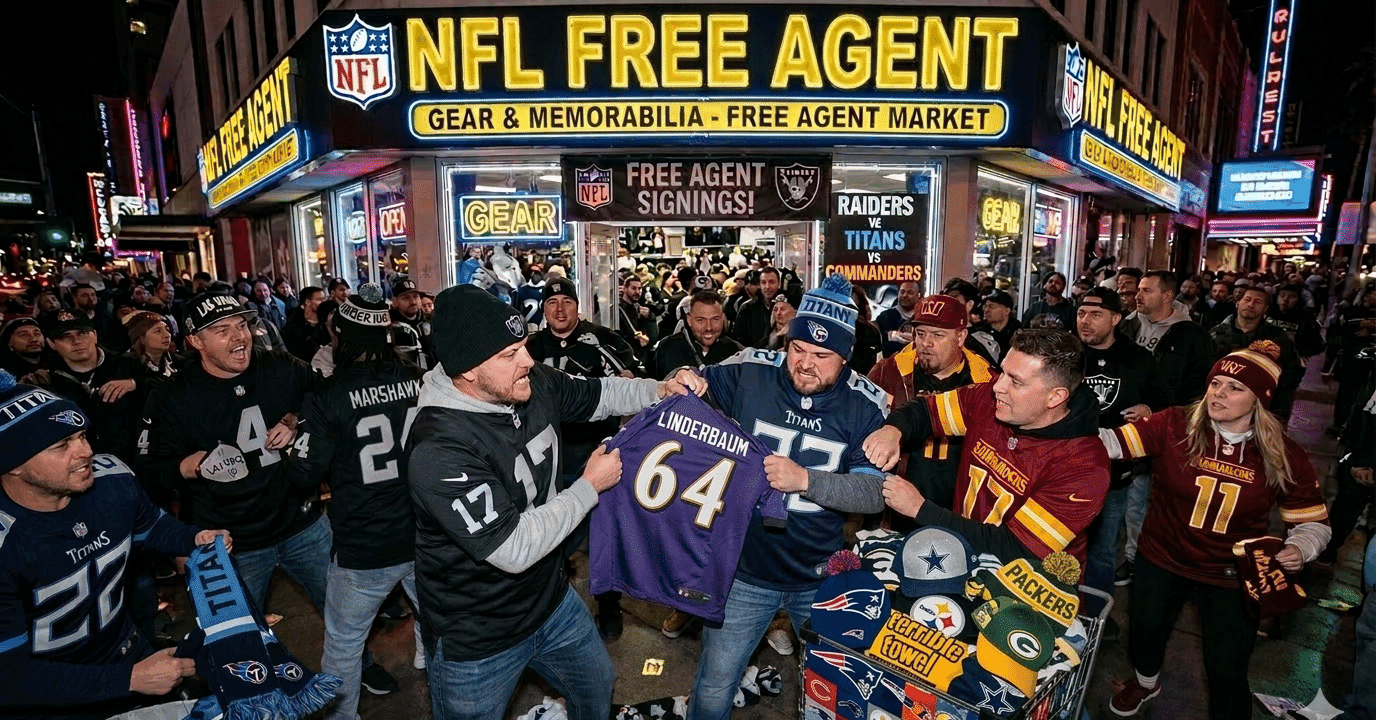
The chaos of FA Day 1 — the Crosby trade and its dramatic reversal:
Free agency opened, and 2026 did not disappoint. Las Vegas traded Maxx Crosby to Baltimore for two first-rounders, spent $281.5M in the first 24 hours of legal tampering, then watched the Crosby deal collapse the next day after a failed physical — with Baltimore pivoting straight to Taron Johnson. Trades falling through on physicals happen. Two-first trades collapsing post-announcement? Genuinely unusual. Easy to enjoy when you're a neutral observer.
As a Saints fan, this was also the first FA opener in years where New Orleans had cap space and was active from the jump — which felt like the right occasion to write a longer piece on the structure of the NFL free agency market and where teams should and shouldn't be directing their resources.
1. Three Ways to Build an NFL Roster
Every NFL acquisition runs through one of three channels: the draft, trades, or free agency. Using them in the right combination is the core of the GM job. Here's a quick breakdown:
The Osweiler reference works best if you were watching in 2016: he signed a massive deal with Houston in free agency, then got traded to Cleveland the following year — with Cleveland receiving a second-round pick in exchange for simply agreeing to absorb his contract. Definitive cautionary tale.
① The draft offers the highest ceiling — cheap, young, four years of controlled cost — but comes with real uncertainty: no NFL track record, unknown scheme fit. ② Trades can net proven stars like Micah Parsons or Maxx Crosby, but the acquisition cost is meaningful. And ③ free agency looks attractive at first glance: NFL-proven players with no draft capital cost.
The problem is that the surface appeal doesn't hold up. Sean Payton has a useful framing:
Sean Payton on free agency as a "garage sale":
Free agency is a garage sale. If you don't do your homework, you bring home broken furniture. The players available are available for a reason. Here's what that means in practice.
2. FA Structural Problem #1: Elite Players at Premium Positions Don't Reach the Market
The foundational constraint: free agents are, by definition, players their teams chose not to extend. Scan any top-101 FA list and the quality gap by position becomes immediately visible. In the NFL, elite players at premium positions — QB, WR, Edge, CB, OT — almost never hit the open market, because their teams retain them first.
Wide receiver is the clearest example. The eight WRs currently averaging $30M+/year: Chase (CIN), Jefferson (MIN), Lamb (DAL), Metcalf (PIT), Wilson (NYJ), AJ Brown (PHI), Amon-Ra (DET), Aiyuk (SF). Not one of them became a free agent after their rookie deal. Pull the threshold down to $25M: still zero. (Alec Pierce technically re-signed in Indianapolis within minutes of legal tampering opening — you can call that FA if you want, but it's functionally a retention.)
2026 WR free agent rankings:
What actually hits the WR FA market: ascending No. 2-type players + high-name veterans on the downswing. Pierce being the one exception at the top of that list — retained immediately — illustrates the rule. The veteran tier makes the WR FA class look more attractive than it is. But sustaining receiver production past 30 is genuinely rare. Jerry Rice is the canonical exception.
Past three years of under-30 WRs, sorted by FA contract value:
- 2025: Darius Slayton, Dyami Brown, Josh Palmer
- 2024: Darnell Mooney, Gabe Davis, Curtis Samuel
- 2023: Allen Lazard, Jakobi Meyers, JuJu Smith-Schuster
The trade market, by contrast, has produced AJ Brown, DJ Moore, George Pickens, Tyreek Hill, Davante Adams — generational players available because of team-side circumstances, not because their performance had declined. For premium talent, trades are categorically better than free agency. WR is the most visible case. QB and Edge follow the same logic.
3. FA Structural Problem #2: The Players You're Targeting Disappear Before the Window Opens
Another underappreciated wrinkle: the available player pool is unknowable until the final hours. Unlike the draft — where the full class is visible months in advance — free agency involves live negotiations right up to the deadline. A target you identified in January can disappear overnight.
3.1. The Franchise Tag
2026 franchise tag deadline — who got tagged:
Mechanism one: the franchise tag. Full breakdown in a separate piece, but briefly — each team can apply the tag to one would-be free agent per year, holding him on a one-year guaranteed deal. The deadline falls roughly two weeks before the FA opening.
This year, George Pickens (DAL), Breece Hall (NYJ), and Kyle Pitts (TE) — all considered among the top available players — were tagged and removed from the market entirely.
3.2. Last-Minute Extensions
Alec Pierce re-signs with IND moments after the legal tampering window opens:
The other disruption: extensions finalized right before or just after the window opens. In 2026 alone, Khalil Mack (LAC, extended Mar. 8 — second consecutive year he's done this), Javonte Williams (DAL, 3y/$24M on Feb. 25), and Pierce (IND, 4y/$114M within five minutes of the tampering window) all effectively never hit the market. Indianapolis couldn't tag Pierce because of a baffling prioritization of Daniel Jones — but they achieved the same outcome through a rapid extension.
4. FA Structural Problem #3: You're Competing Against Teams With Nothing Else to Spend On
4.1. Rebuilding Teams Carry Enormous Cap Space
Problems #1 and #2 are about supply. Problem #3 is about competition — even when a quality player does become available. The NFL cap structure virtually guarantees that in any given offseason, at least one team is deep in a rebuild: carrying mostly rookie-contract players, trading veteran assets for picks, and sitting on unused cap space with nowhere obvious to put it.
Las Vegas entering FA with $103.6M in cap space:
Las Vegas this year was the extreme case: $103.6M in cap space heading into the window. Unlike the draft (where your pick slot matters) or trades (where your asset quality matters), free agency is a near-pure financial competition. You cannot systematically outbid a team with $100M to burn.
The natural result: FA contracts routinely clear prices that feel irrational in isolation. The Raiders' Day 1 was extraordinary — Tyler Linderβ€aum signed at roughly 1.5× what Creed Humphrey (KC, arguably the No. 2 center in the league) earned at $18M/year, setting a new market high.
Linderβ€aum's record deal with Las Vegas:
4.2. Rebuilding Teams Have No Compensatory Picks to Protect
The further asymmetry comes from the compensatory pick system:
- When a team loses a free agent above a certain salary threshold, it's awarded a compensatory draft pick in rounds 3–7 (up to four per year)
- Acquiring a free agent of comparable value cancels the pick — the two offset each other
Lose a $20M/year FA, receive a third-round comp pick. Sign a comparable incoming FA, the pick disappears. This year, Baltimore's third-round comp from losing Linderβ€aum will be cancelled out by the Hendrickson signing. Which means every team has to factor their compensatory pick exposure into FA acquisition decisions — and some are explicit about it:
JAX explaining their compensatory pick philosophy publicly:
But — here's the structural asymmetry — rebuilding teams don't have this exposure. If you're LV, TEN, or CAR, you don't have high-value players hitting free agency. Everyone worth keeping is extended or traded. Your outgoing FA class generates at most sixth- or seventh-round comp picks. The teams spending most aggressively in FA are precisely the teams with the least to lose from that spending — because they have no meaningful comp pick projections to protect.
[Sidebar: Who's best at accumulating comp picks?]
Teams that consistently avoid big FA spending and retain their own players reliably build comp pick pipelines. LAR and BAL are the clearest examples — both collect thirds or fourths nearly every year and use them to trade up or reinforce depth.
Teams maximizing their compensatory pick haul each offseason:
The Over The Cap compensatory pick tracker makes this visual. Teams that carefully avoid comp pick cancellations — JAX, DEN, PHI, GB, SF this year — are mostly legitimate contenders. Not coincidental.
5. Where Should Teams Focus in Free Agency?
Given all of the above, "being aggressive in free agency" is less unconditionally positive than it's usually described. Teams spending heavily in FA tend to do so because:
- They have few quality players due for retention
- Their draft capital is limited
- They have no comp picks at risk
- They're obligated to hit the salary floor — the CBA requires teams to spend at least 89% of the cap across any rolling four-year window, on a cash basis
Much of the FA spending you see is compulsion as much as strategy. The team getting criticized every March for "standing pat" in free agency might just be protecting a third-round comp pick. Inactivity isn't automatically neglect.
My view: relying on FA to fill primary roles at premium positions — WR, Edge, cornerback — is structurally disadvantaged. Here's where free agency spending actually makes sense.
5.1. Running Back
First and most clearly: running backs. The case against FA at premium positions inverts almost entirely at RB.
Reason 1: RB salaries haven't inflated with the cap
The usual FA concern — systemic overpaying — barely applies here. RB is essentially the only position where salaries have not risen proportionally with the salary cap. Even modest overpaying lands well within acceptable range.
 RB salaries have not kept pace with cap growth (via FiveThirtyEight)
On a guaranteed money basis, the gap is even more pronounced. Drafting a RB in the top 10 in 2026 means guaranteeing $30M+. The 2024 FA class: Barkley at 3y/$26M guaranteed, Henry effectively one year at $16M, Jacobs at $12.5M guaranteed (also effectively one year). Even the best running backs can be signed on near-annual terms — the opposite of every premium position.
Reason 2: Top RBs actually reach the market
2026 RB free agent class — top available players:
Teams simply don't prioritize extending RBs the way they do receivers or pass rushers. This year's class includes Super Bowl MVP Kenneth Walker (SEA→KC, age 25) and Travis Etienne — three 1,000-yard seasons in four pro years — heading to New Orleans at 26. Even in a "thin" year, the 2024 class delivered Josh Jacobs (LV→GB), Saquon Barkley (NYG→PHI), and Derrick Henry (TEN→BAL) — three players who would rank among the best at their position the following season — all available in the same market.
An All-Pro RB changes games. Pass-catching ability, forced missed tackles, the home-run threat on any carry. SF without CMC and NO without Kamara both look very different. The probability of landing an All-Pro-level player through FA is negligible at WR. At RB, it's a realistic possibility in most years.
5.2. Other Non-Premium Positions
Running back is the clearest case, but several other positions share similar FA-friendly dynamics. Common threads:
- The franchise tag is difficult or uneconomical to apply
- Performance is harder to quantify (making teams less confident in paying a premium to retain)
- Age curve is favorable (high-quality play continues into the 28–31 range)
ILB: Off-ball linebackers are already undervalued in the draft. Compounding that: applying the franchise tag to an ILB means computing salary using the top-5 LB average — dominated by outside linebackers (pass rushers) — making it economically irrational. That structural inefficiency means quality ILBs are more likely to hit the open market. Clear performance metrics are limited, and age curves are favorable — Demario Davis, Bobby Wagner, and Lavonte David all played at an elite level well into their 30s.
OG/C: Interior OL has the same tag problem from the other direction — the OL tag pools all five positions together, pulled upward by tackle salaries, making it expensive relative to what guards and centers actually earn. Teams that extend their tackle often let the IOL walk. Linderβ€aum-level bidding wars are the worst-case outcome, but IOL is typically an efficient FA target.
Safety: Tag values have been historically modest, so elite safeties are sometimes tagged — but quality starters reach the market with regularity. Jessie Bates III (CIN→ATL, 2023) and Xavier McKinney (NYG→GB, 2024) both had strong first seasons with their new teams.
Worth noting: right after this piece was originally published, @VoxAnalytics shared supporting data — the positions with the highest concentration of top-tier players in FA are IOL, LB, and S, in that order.
Positional FA rate data showing IOL, LB, and S overrepresented among top players:
5.3. Veteran "Final Piece" Additions for Contenders
High-profile veteran WRs entering the 2026 FA market:
Back to premium positions: young elite players don't materialize through FA. But marquee veterans do. They won't fix long-term roster structure, but one or two productive years is realistic. The scenario where this actually makes sense: a contender that has already constructed its core through the draft and trades, adding a high-profile veteran as a targeted final piece.
Last year, LAR's Davante Adams acquisition and BUF's Joey Bosa signing both played out reasonably well for their respective teams. Whether SF's Mike Evans (age 31) signing this year fits the same template is worth watching.
The hard constraint: this only works when the surrounding roster is already legitimate. A team still multiple years from contention adding a 32-year-old receiver isn't the same calculation. Teams like LV and TEN targeting players in their mid-to-late 20s — shown below — are building a coherent age curve. That's the right instinct.
(NYJ taking Demario Davis while Geno Smith is the starter is a separate conversation. Some things haven't changed.)
LV and TEN targeting younger free agents vs. teams chasing veteran names:
6. Conclusion: Free Agency Supports Rosters, It Doesn't Build Them
The through-line: premium positions and free agency are structurally mismatched. The best players don't reach the market. The ones who do were passed over for a reason. And when good players do break through — Tyler Linderβ€aum this year — you're competing against teams with $100M+ in space and nothing else to spend it on.
The inverse is constructive: the draft and internal development matter far more than the FA narrative usually suggests. Lock up your best players on extensions, hit on your draft picks, use FA to address depth at non-premium positions. That's the sustainable template for lasting contention.
On Las Vegas specifically: the price premiums are structural — that's just what FA does — but the direction is broadly right. Linderβ€aum and two ILBs (all non-premium) at market-rate; WR, DE, and CB filled with solid starters at manageable prices. The Crosby trade collapsing was actually a fortunate outcome for the Raiders — he's 28, he shouldn't have been on the move in the first place. If they hit on a few draft picks and those mid-20s FA signings develop, this is a real team in two years.
Las Vegas' complete 2026 FA haul:
The most useful lens on any FA period isn't "what did they acquire" — it's "why is this player available?" Apply that question consistently and the signal-to-noise ratio gets considerably better.
Thanks for reading.