This month, two separate NFL stories put the phrase "poison pill" in headlines: the Micah Parsons trade (DAL to GB) and the Brandin Cooks release (NO). Both are worth explaining. But if you want to understand what a real poison pill looks like in the NFL — one ruthless enough to permanently change the CBA — those two examples barely scratch the surface. The Steve Hutchinson saga of 2006 is the story. Let's start from the beginning.
1. The Business Term: Poison Pill — The Twitter/Musk Case
"Poison pill" is business jargon before it's an NFL term. Formally known as a Shareholder Rights Plan, it's a corporate takeover defense mechanism that most people encountered in real time when Elon Musk tried to buy Twitter.
The tweet that kicked off the whole saga:
When Musk started buying up shares and made his initial acquisition offer, Twitter's board responded by adopting a new rule:
If any single shareholder accumulates more than 15% of outstanding shares, all other shareholders gain the right to purchase new shares at a discount.
Why does this work? Because it makes the acquisition math brutal. The moment you hit 15%, the pool of shares expands — diluting your stake back below that threshold and forcing you to spend significantly more than you planned. Twitter used this to extract better terms before the deal ultimately went through ten days later.
The core mechanism — and this is what makes it a "poison pill" — is:
Crossing a certain threshold makes a specific action prohibitively expensive
⇨ That action becomes effectively impossible without explicit permission
It's not a ban. It's a trap. The name allegedly comes from WWII-era spies carrying cyanide capsules in case of capture — something you'd only use under the most extreme circumstances.
("Poison Pill" as a phrase — the etymology:)
2. NFL Poison Pill #1: The Micah Parsons Re-Trade Block
The same principle applies in NFL contracts. A poison pill clause doesn't prohibit an action outright — it just makes the cost of that action so high that it's functionally off the table.
Adam Schefter on the Micah Parsons trade details:
The Parsons trade is a clean, low-stakes example. The reported terms included:
- If GB trades Micah Parsons to an NFC East team, GB owes DAL a 2028 first-round pick
- If DAL trades Kenny Clark to an NFC North team, DAL owes GB a 2028 first-round pick
I have plenty of petty questions about this — does GB really care that much about Kenny Clark ending up in their division? Is a pick going to PHI actually scarier than Aaron Jones suiting up for Minnesota? — but the underlying logic is clear: both teams don't want the player they sent away coming back to haunt them in division play. DAL's concern is particularly understandable given reports that Philly had actually made an offer.
Here's the catch: you cannot simply write "this player cannot be traded to our division rivals" into an NFL contract. The CBA prohibits restricting player movement that way. The poison pill is the workaround — you can trade him wherever you want, but if it's our division, you owe us a first. The penalty doesn't prohibit the action. It just makes the cost high enough that no rational GM would do it.
The mechanism mirrors conditional pick arrangements (e.g., a second-round pick that escalates to a first if the player hits certain snap counts). The creativity is in the structuring. The reported limitation: these protections only apply through the 2026 season.
3. NFL Poison Pill #2: The SEA-MIN Poison War
A reply to Schefter's Parsons post raised an obvious question: wasn't the NFL's poison pill banned?
"Wasn't the NFL poison pill banned?" — a reply to Schefter:
Understandable confusion. In NFL salary cap lore, "poison pill" is almost synonymous with one specific event: the Steve Hutchinson saga of 2006, which triggered a rule change that still governs offer sheets today. Here's the full story.
About Steve Hutchinson:
3.1. About Steve Hutchinson
Hutchinson is one of the best interior linemen of his era. Drafted in the first round by Seattle in 2001, he made seven consecutive Pro Bowls from 2003 to 2009 — five of them First Team All-Pro — and was inducted into the Hall of Fame in 2020.
He was the anchor of Mike Holmgren's Seahawks alongside left tackle Walter Jones (also a Hall of Famer), and was a key part of the team's run to Super Bowl XL. That year, Shaun Alexander won the MVP — which tells you something about what the offensive line was doing.
A recent tweet about Hutchinson and the whole saga:
3.2. The Transition Tag Sets the Stage
Coming off that Super Bowl run, Hutchinson's contract expired in the 2006 offseason. Seattle couldn't get an extension done and decided to use a tag — but instead of the franchise tag, they went with the transition tag. That decision was the crack in the wall.
The transition tag works like this:
- It lets the team keep a player at a lower salary than the franchise tag
- Unlike the franchise tag, other teams can make competing offers
- But if another team does make an offer, the original team can match it exactly and retain the player
Seattle's thinking was essentially: an offer probably won't come, and if it does, we'll match it. The $0.6M in savings seemed worth the risk. The cap hit on offensive guards was also lower in that era than it would later become.
(Worth noting: in the franchise tag article, I mentioned that the transition tag is rarely used today. The Hutchinson incident is one of the main reasons why.)
3.3. Minnesota's Poison Pill
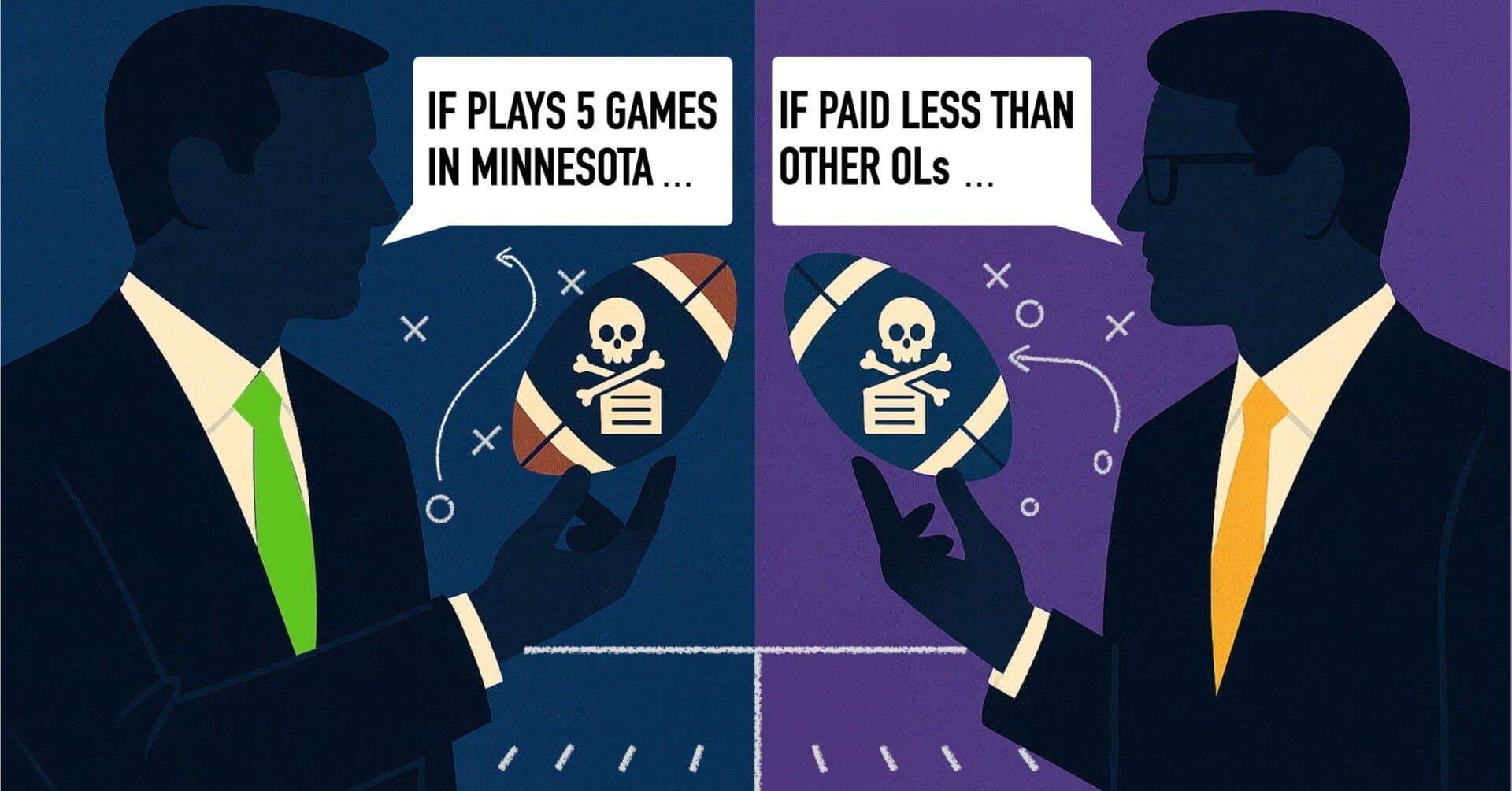
Seattle's assumption fell apart fast. Minnesota came in with a 7-year, $49M offer — aggressive but not insane for the market. The number wasn't the problem. The problem was a single clause buried in the contract.
If any offensive lineman on the team is paid more than Hutchinson at any point during the contract, the entire seven-year deal becomes fully guaranteed immediately.
For Minnesota, this was window dressing. They had no OL making more than Hutchinson. The clause did nothing to them. But for Seattle? Walter Jones was locked into a 7-year, $50M+ deal — making him the highest-paid lineman on the roster by a comfortable margin.
Under the transition tag rules, once Minnesota made their offer, Seattle's options were binary: (1) match the offer exactly, or (2) let Hutchinson walk with no compensation. If they matched:
Walter Jones becomes the higher-paid OL
→ The clause triggers instantly, making all 7 years of Hutchinson's deal fully guaranteed
→ Mathematically impossible under the cap structure of the time
Option 1 was gone. Seattle couldn't match. Hutchinson went to Minnesota with zero draft pick compensation in return. Holmgren was reportedly furious — and rightfully so. The franchise tag would have prevented any of this from happening.
3.4. Seattle's Counterstrike
What makes this story genuinely entertaining is that Seattle hit back. Immediately. They went after Nate Burleson, a restricted free agent wide receiver for Minnesota who was one of the Vikings' most promising young players. The offer: 7 years, $49M — almost identical to what Minnesota paid for Hutchinson — plus their own poison pill:
If Burleson plays five or more games in Minnesota in any season, the entire contract becomes fully guaranteed.
Seattle plays in Washington. This clause was pure fiction for them. For Minnesota? The moment they matched, the guarantee locked in. They couldn't touch it. Burleson went to Seattle without compensation, just as Hutchinson had come to Minnesota.
(Burleson, for the record, never came close to justifying that contract as a player. You still see him on TV occasionally. The irony is complete.)
3.5. The Hutchinson Rule
The two trades stuck — neither was reversed. But the spectacle dragged in the rest of the league's ownership, and the outrage was sufficient to drive real rule changes. If poison pills could be structured like this, the transition tag was basically useless as a retention tool.
When the current CBA was negotiated in 2011, the following language was added:
No Offer Sheet may contain a Principal Term that would create rights or obligations for the Old Club that differ in any way … (i.e., no "poison pills").
"The key terms of an offer sheet must create identical rights and obligations for both the old and new club. Poison pills — terms that trigger differently depending on which team holds the contract — are prohibited."
This is the Hutchinson Rule. The specific mechanism it blocks: clauses that mean one thing for Team A (nothing) and something catastrophic for Team B (full guarantee triggered immediately). Terms must be symmetrical.
(The Parsons trade structure survives this rule because the penalty is attached to the trade compensation, not to the contract terms themselves. Structurally different.)
For the record: later that 2006 season, SEA and MIN played in Seattle. Every time Minnesota's offense took the field, Hutchinson included, the crowd booed them mercilessly. Then Hutchinson threw a block that sprung a 95-yard touchdown run — the longest in Vikings franchise history at that point — and Minnesota won the game. SEA deserved every second of it.
This SI piece has great on-the-record quotes from Holmgren and others — worth reading if you want the full behind-the-scenes of what was going through everyone's heads.
A look back at the SEA-MIN rivalry and this saga:
4. NFL Poison Pill #3: The Brandin Cooks Situation
The Brandin Cooks release:
After the Hutchinson saga, anything else looks like a footnote. But the Cooks situation is recent, so here's a quick rundown.
The Saints entered 2025 thinking they could compete. Then Derek Carr abruptly retired, leaving three rookie-contract QBs with a combined zero career wins as the depth chart. New Orleans was 1-9 at the trade deadline. Cooks — a veteran who signed to play on a contender, not mentor a rebuilding room — formally requested his release. The Saints agreed, on the condition that he waive some future guaranteed money to reduce the dead cap hit.
The complication: releasing a player after the trade deadline means he goes through waivers. There was a real risk Cooks would end up on a bad team — completely defeating the purpose of the whole arrangement. So New Orleans restructured his deal to include this:
As of November 21st, Cooks's 2026 fully guaranteed money increases from $1.69M to $5.94M.
The Saints would release him November 20th — before the clause kicked in — so they owed nothing extra. But any team that claimed him on waivers would immediately inherit a $6M guarantee on a 32-year-old with 165 receiving yards on the season. The intent was to discourage waiver claims.
The league stepped in and blocked it. NFL waiver rules prohibit restructuring contracts specifically to make a player harder to claim. The Saints ultimately couldn't use the clause — the release went through clean, no penalties, no fine, no draft picks stripped.
My honest reactions: at 32 with 165 yards this year, he was probably going to clear waivers anyway. The Saints should have traded him before the deadline. And maybe know the waiver rules before trying to game them.
5. The Loopholes That Remain
The Hutchinson Rule closed a specific window. It didn't close all of them. Parsons and Cooks both show there's still room to engineer creative deterrence. Here are two more examples — one historical, one hypothetical.
5.1. Could Anyone Have Stolen Lamar Jackson?
In the 2023 offseason, the Ravens placed a non-exclusive franchise tag on Lamar Jackson, meaning other teams could negotiate with him. If a team signed him, Baltimore could match the offer and keep him — but if they couldn't match, they'd lose Jackson and only receive two first-round picks in return.
So the obvious question: could a team have built an offer that Baltimore genuinely couldn't match?
The Hutchinson Rule prohibits contract terms that work differently for one team versus another. But it doesn't prohibit contracts that are simply expensive. "A $100M cap hit in year one" is the same for everyone — it just happens to be impossible for a team already close to the cap. Cap nerds were floating all kinds of structures at the time:
 An Over The Cap illustration of a Lamar Jackson poison pill–type offer, featuring a $250M roster bonus in year three designed to make matching impossible for Baltimore
Nobody made the offer. Not even close. Looking at how Jackson has played since, there are definitely front offices that wish they'd tried.
 The QB purgatory that followed "we don't need Lamar Jackson" — featuring Desmond Ridder's stats
A quick aside: The Almost-Move of Alex Mack (CLE, 2014)
In 2014, Jacksonville offered Alex Mack (then on a transition tag with Cleveland) a front-loaded contract — identical terms for both teams under the Hutchinson Rule, but structured in a way that made it genuinely painful for Cleveland to match given their cap situation. Cleveland matched anyway, Mack stayed — then got hurt and was released the following year. He went on to have a great career in Atlanta and San Francisco. Because of course he did. Browns.
5.2. The Most Shameless Poison Pill in Sports History — Sergei Fedorov (NHL, 1998)
One more, and it's my favorite example in any sport.
In 1998, the Carolina Hurricanes — a team that had missed the playoffs for six straight years — made an offer to Sergei Fedorov, the superstar center for the Detroit Red Wings. Detroit were the reigning Stanley Cup champions and had reached the Conference Finals four years running.
The Hurricanes' offer included this clause:
If the team advances to the Conference Finals in any season of the contract, Fedorov receives an immediate $12M bonus.
On paper: a straightforward performance incentive. In reality: Detroit had literally just done that four years in a row. Carolina had never come close. The clause was guaranteed money if Fedorov stayed in Detroit, and essentially meaningless if he actually went to Carolina.
The league rejected the contract once. An arbitrator reinstated it. Detroit matched — and then, in a moment of perfect sports justice, actually advanced to the Conference Finals that year, paying Fedorov one of the largest single-season paydays in NHL history at that point. He ended up spending most of his career in Detroit and is remembered as a franchise legend.
The Fedorov/Carolina case revisited:
This structure — an incentive clause that's nearly risk-free for one team and a near-certain trigger for the other — is technically legal in the NFL. If Patrick Mahomes were ever on a non-exclusive tag (120% not happening), the dream scenario writes itself:
"$100M bonus if the team reaches the Super Bowl"
"Contract becomes fully guaranteed with a division title"
— offered by the worst team in the league
The only problem: Mahomes would probably drag a bad team to the AFC Championship Game inside one year and the whole plan would backfire spectacularly.
6. Final Thoughts
The Hutchinson Rule banned the most egregious versions of this. But "most egregious" is a narrow category. The Parsons and Cooks examples show that creative cap architects still have room to work. As long as the rules have gaps, someone will find them.
The NFL has always had front offices willing to push the edges of what's permitted — that's what makes salary cap management one of the genuinely fascinating subplots of the league. Expect more new variants of the poison pill in the years ahead. As a cap nerd, I'm looking forward to it.
Thanks for reading.