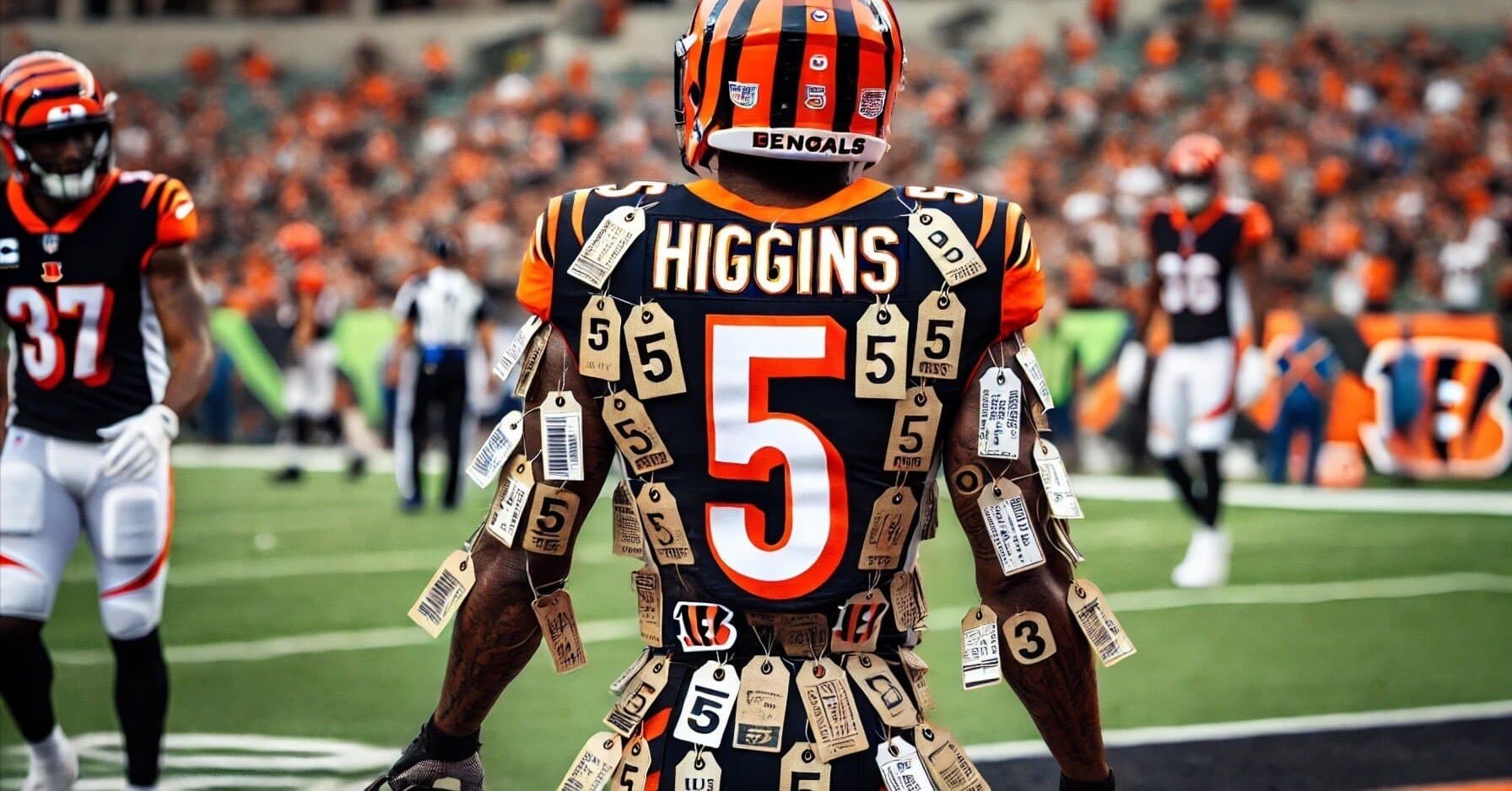
March in the NFL: the league year turns, free agency opens, and the Saints restructure somebody's contract whether they need to or not. But before any of that kicks off, there's one deadline that quietly shapes the entire offseason — the franchise tag window. This year, only two players got tagged league-wide. The headliner: Tee Higgins in Cincinnati, for the second straight year.
Tee Higgins franchise-tagged by CIN for the second consecutive year:
I've written about fifth-year options and dead money, but never gotten around to the franchise tag — so this felt like the right moment. The NFL's contract system is genuinely one of the most sophisticated labor frameworks in professional sports (the more you look at Shohei Ohtani's deferred contract structure in MLB, the more that becomes obvious), but the franchise tag is a rare exception: a mechanism I'd like to see reformed, if not eliminated.
Part 1 covers the basics of how the tag works, the three reasons teams use it, and the reasoning behind this year's key tag/no-tag decisions. Part 2 will get into the specific problems with the system.
1. What Is the Franchise Tag?
A quick primer — feel free to skip ahead if you're already familiar.
1.1. The Franchise Tag: A "Stop the Bleeding" Mechanism
How the tag interacts with the free agency calendar:
Every mid-March, the NFL's new league year begins — and with it, free agency opens. Any player without a contract for the upcoming year becomes an Unrestricted Free Agent on that date, free to negotiate with all 32 teams.
Ideally, teams lock up players they want to keep well before FA opens. That's increasingly the norm in the modern NFL, which is part of why tag usage has declined. But for various reasons, teams occasionally find themselves with a player they want to retain and no extension in place:
- A player broke out in the final year of his deal — e.g., Jaylon Johnson (CHI)
- Injury concerns made long-term commitment difficult — e.g., Saquon Barkley (NYG)
- Extension or trade talks stalled — e.g., Brian Burns (CAR)
The franchise tag, introduced in 1993, is the mechanism designed for exactly this situation. Each team gets one tag per year. Apply it to a player before the roughly one-week window ahead of the FA start date, and you lock him into a fully guaranteed one-year deal at the average of the top five contracts at his position over the past five years. Think of it as a unilateral one-year contract extension — the team's emergency brake against losing a valuable player to free agency.
[Historical note: FA and the franchise tag were introduced simultaneously]
The unrestricted free agency system — where players with sufficient service time can negotiate with any team — was introduced in the same 1993 collective bargaining agreement that created the franchise tag. The tag was owners' proposed solution to a concern that unrestricted FA would cause franchise players to move too freely between teams. It was marketed as a way for teams to "protect" their most important players — which, depending on your perspective, is either a feature or a bug.
1.2. Two Types, But Basically Just One That Matters
There are technically three tag types: the exclusive franchise tag, the non-exclusive franchise tag, and the transition tag. In practice, almost everything you'll see is the non-exclusive franchise tag — the transition tag in particular is rarely used and not worth the mental overhead.
The Non-Exclusive Franchise Tag:
- Applies a one-year, fully guaranteed contract at the average of the top-5 salaries at the player's position (or 120% of the player's previous-year salary, whichever is higher)
- Non-exclusive: the player can negotiate with other teams
- If another team makes an offer, the original team can match it and retain the player
- If the original team doesn't match, the new team must send two first-round picks (current year and the next) as compensation
The two-first-round compensation requirement is, in practice, a near-prohibitive barrier. For virtually any non-QB player, the price of acquisition is simply too high for any competitor to rationally pay. So despite the "non-exclusive" label, tagged players are functionally limited to negotiating with the team that tagged them — the tag functions as a temporary monopoly.
The alternative — the exclusive franchise tag — removes all outside negotiation but costs the tagging team a slightly higher salary. The prevailing logic: "Nobody's going to trade two firsts for this guy anyway, so just use the non-exclusive and save the money."
Here's the 2025 franchise tag breakdown by position. They're based on top-five averages, so they're inherently elevated — but the variation across positions is striking. $25M for a linebacker looks expensive; $13M for a running back can look like a bargain depending on the player. That gap is a big part of why the tag plays out so differently depending on position — more on that in Part 2.
2025 franchise tag values by position:
[Sidebar: Lamar Jackson was non-exclusively tagged even as a top-3 QB]
The most notable recent example of a top player getting the non-exclusive tag: Lamar Jackson in 2023. The conventional wisdom at the time was that any team would happily part with two firsts to land a MVP-caliber QB. No team did. Jackson re-signed with Baltimore on a long-term deal, and Baltimore's GM came out looking prescient — and Jackson, for what it's worth, went through the process, confirmed his market, and signed what he could feel good about. Solid outcome for both sides. The Ravens front office has been consistently excellent.
Meanwhile, the Falcons' owner went on record the day after the tag saying they didn't need Jackson because of Desmond Ridder, and that Jackson's style wouldn't hold up long-term due to injuries. This was embarrassing enough that it barely needs commentary.
[Sidebar: The one-per-year rule bit the 2023 Giants]
The "one tag per team per year" rule rarely causes problems — if you're scrambling to tag multiple players, your offseason planning failed somewhere upstream. But the 2023 Giants were a legitimate exception. Fourth-year QB Daniel Jones (on the last year of his rookie deal, with the fifth-year option declined) and fifth-year RB Saquon Barkley both delivered strong enough seasons to carry New York to its first playoff win in six years. Suddenly, the team wanted both back — and could only tag one.
- Daniel Jones: extended on a 4-year, $160M deal right before the tag deadline
- Saquon Barkley: tagged for one year
Neither outcome aged well. Barkley's extension talks broke down, he ran for a quiet final season in New York, then left for Philadelphia. Jones declined sharply and was ultimately released. Front office decisions operating under uncertainty, in real time — genuinely difficult.
2. The Three Reasons Teams Use the Tag
What's the actual purpose when a team decides to tag someone? The honest answer is it depends — but most tag decisions fall into one of three categories (often with a "try 1, fall back to 3" or "aim for 2, settle for 1" logic layered in):
2.1. Buying Time for an Extension
The most common use case. Classic scenario: a player breaks out in year four of his rookie deal, and the team needs more time to nail down a long-term extension. With a tag in place, the team has until mid-July to sign a multi-year deal. If they get there, the tag contract evaporates and the extension replaces it. In 2024, five of the eight tagged players — Josh Allen (JAX), Jaylon Johnson (CHI), Michael Pittman (IND), Justin Madubuike (BAL), and Antoine Winfield (TB) — had extensions done by May.
A 2024 example of tag-then-immediate-extension:
This plan doesn't always go smoothly. Players can refuse to play on the tag, or negotiations can collapse and the situation slides toward Option 2 or 3.
2.2. Tag and Trade
Sometimes the goal isn't extension — it's monetizing the player through a trade rather than letting him walk for a compensatory pick. If a player hits free agency and signs elsewhere, the original team's maximum haul is a third-round compensatory pick. For a player who might fetch a second or first in a trade, that gap is significant.
The conditions that need to hold for this to work:
- A realistic trade market exists for this player
- That trade market will clear a third-round pick or better
- If no trade materializes, having the player on the tag for one year isn't a disaster
That last point is what limits this to high-value, high-demand positions — in practice, Edge rushers and wide receivers. And the pattern has spiked since 2018.
Tag-and-trade examples since 2010:
- 2018 — Jarvis Landry (WR, MIA → CLE)
- 2019 — Frank Clark (DE, SEA → KC)
- 2019 — Jadeveon Clowney (OLB, HOU → SEA)
- 2019 — Dee Ford (DE, KC → SF)
- 2020 — Yannick Ngakoue (DE, JAX → MIN)
- 2022 — Davante Adams (WR, GB → LV)
- 2024 — Brian Burns (OLB, CAR → NYG)
- 2024 — L'Jarius Sneed (CB, KC → TEN)
Acquiring teams are paying full trade price, which means they almost universally extend the player immediately — often same day. The exceptions above are Clowney and Ngakoue, who refused to practice with their tagged teams so long that the July 15th extension deadline passed before the trades went through. That kills negotiating leverage and invites salary offset demands. Not ideal for anyone involved — and the fan bases of those Houston and Jacksonville teams deserve a medal for their patience.
A tag-and-trade example (Clowney to SEA):
One underrated advantage for teams trading a tagged player: the tag salary is treated as base salary for cap purposes, carrying zero dead money. Clean exit if you get the right offer.
2.3. Just a One-Year Deal
The least common outcome — using the tag as a genuine one-year bridge with no extension or trade intent. "We want you here this year, but we're not ready to commit long-term." The player typically hits free agency the following year.
An example of RBs being tagged purely for one year:
The most memorable recent example: the 2023 running back cluster. Saquon Barkley (NYG), Josh Jacobs (LV), and Tony Pollard (DAL) all got tagged. Running backs are a hard sell for long-term deals given injury and age curves — but the position's declining market value means the top-5 average doesn't come out much higher than a reasonable extension anyway. One quality year at $10M with no long-term risk feels like the right answer for a team with an aging backfield ace. None of those three ended up extending with their respective teams; all three hit FA the following year.
TEs and safeties also show up in this pattern fairly often, again because the tag values at those positions are historically modest (though both have been trending upward as the top earners push the averages higher).
- TE examples: Hunter Henry (LAC), Dalton Schultz (DAL), Mike Gesicki (MIA)
- Safety examples: Marcus Maye (NYJ), Marcus Williams (NO), Jessie Bates (CIN)
3. Reading This Year's Tag Decisions
I don't have a rooting interest in any of the teams involved here, so take this as outside-observer analysis. Three situations from this year's tag cycle stood out.
3.1. Why Tee Higgins (CIN) Got Tagged
The most-discussed tag of the cycle. My read on the Bengals' front office thinking: "All three options are on the table — extend him ideally, trade him if the right deal appears, or have him play on the tag if neither works."
CIN tags Higgins for the second straight year:
The Bengals are notoriously slow to finalize extensions (the ownership situation in Cincinnati constrains cap flexibility), but the larger structural reason they can't commit long-term to Higgins right now is that Ja'Marr Chase — the WR they value even higher — is due for an extension that's expected to land at the very top of the non-QB market. Locking up Chase first before stacking a big Higgins deal on top makes sense. The tag buys time until July; get Chase done first, then figure out what's left for Higgins.
At the same time, paying $35M and $30M to two receivers simultaneously isn't viable, so releasing Higgins has become a realistic option this year in a way it wasn't in 2024. Still: Higgins is a 25-year-old WR with multiple 1,000-yard seasons, and the trade market for him is almost certainly good enough to clear a second-round pick minimum. Letting him walk and taking a compensatory third would be a significant value miss. Even at a $26M tag (1.2× last year's $21.8M), playing on the tag is a reasonable outcome if the trade market doesn't materialize.
From Higgins' side: he handled the first tag gracefully — no holdout, no public drama — which was admirable. But WR market value erodes with age, and the injury risk is real. At some point this offseason, pushing for a trade request or skipping training camp is probably the right leverage play. The Bengals are committed to Chase at all costs, which limits what Higgins can realistically extract in an extension; a trade with an immediate extension attached might be the best outcome available to him.
Incidentally — I assumed that being tagged twice generally means no extension happens. Turns out the data says roughly 50/50.
Data on what happens after a second consecutive franchise tag:
3.2. Why Trey Smith (KC) Got Tagged
Similar to Higgins — but I lean more toward Option 2 (trade) here than I did with Higgins.
KCのTrey Smithへのタグを伝えるツイート:
The reasoning: the guard tag ($24M) is too expensive to be attractive as a pure one-year bridge. And if Kansas City genuinely intended to extend Smith long-term, they'd have done it already — he's 25, he's a Pro Bowler, and this isn't a situation where the team needs more time to evaluate. The extension window had months.
Layer in the fact that Kansas City has a pattern of tag-and-trade moves (Dee Ford, L'Jarius Sneed), and a cap picture that isn't flush, and a trade feels like more than a possibility depending on what's offered. A young Pro Bowl guard should clear a third-round pick without much difficulty. (The caveat: last year's Sneed situation had trade permission granted at the time of tagging, which made the destination pretty clear. This one is less obvious. And trading yet another interior OL piece right after moving Chuney raises questions.)
The broader KC dynamic is just: Mahomes absorbs $60M+/year, which compresses everything else. The Chiefs have made their peace with the model — invest heavily in a few foundational pieces, draft the rest. They're good at identifying when to move on and maximizing return. Whether McDuffie gets extended (or eventually tagged and traded) will be an interesting test case.
3.3. Why Sam Darnold (MIN) Didn't Get Tagged
The setup: Darnold signed a one-year backup deal with Minnesota in 2024. J.J. McCarthy — the first-round pick groomed as the franchise QB — suffered a season-ending injury in the preseason. Darnold stepped in, vastly exceeded every expectation, went 14-3, threw for 4,300 yards and 35 TDs, and made the Pro Bowl. Minnesota lost in the playoffs, but the regular season was legitimately one of the best single-season performances by a journeyman QB in recent memory.
Darnold's 2024 season by the numbers:
This is the kind of situation that's genuinely hard to process as a GM in real time. The options:
- Tag him and negotiate a long-term extension as the starter
→ You've now buried J.J. McCarthy, your $14M (slot value) first-round investment. And if last season was a system fit / contract-year outlier, you've paid starting QB money for a backup-quality player. - Tag him and trade him
→ The QB market is binary — each team has exactly one starter slot — and without a bidding war, getting more than a third-round pick in a trade is far from guaranteed. If no trade materializes, you're carrying a $40M backup. - Let him walk as a free agent
→ If McCarthy turns out to be a bust and Darnold was actually the real thing in Kevin O'Connell's system, you've given away a legitimate starter for a third-round compensatory pick.
Minnesota went with Option 3 — no tag. The deciding factor is the QB tag salary: $40M is simply too expensive a hedge for a team that has already committed to another direction at the position. A cheaper tag would probably have changed the calculus.
O'Connell's post-playoff press conference on Darnold:
Watching that press conference, you could tell the decision had already been made — the language felt more like a goodbye than a seasonal recap. The sense I get is that "McCarthy in 2025" was essentially baked into Minnesota's planning regardless of what Darnold did in the regular season. Whether that's right will play out over the next few years. But the current Vikings front office and coaching staff have been consistently clear-eyed and decisive about these calls — even when they sting — and that's worth something.
[Sidebar: This rhymes with the 2021–22 San Francisco situation]
In 2021, the 49ers traded up to take Trey Lance third overall, then spent the year letting him develop while Garoppolo started. Garoppolo wasn't the dominant force Darnold was — but he was competitive enough to push San Francisco within one game of the Super Bowl. The team then had to decide what to do with a starting-quality QB on a big contract they no longer wanted to pay. They found a creative middle path: restructured the deal, kept him for one more year, then moved on. The full story of how that played out is here. The Darnold situation is harder in some ways — at least Garoppolo had a contract to work with. But in both cases, you wonder: would either team's calculus have shifted if they'd gotten a little further in the playoffs?
4. Up Next: What's Actually Broken About the Tag System
I had intended to pivot directly into the system's flaws — but this went long. Part 2 will cover the specific problems with the franchise tag and what I'd change about it.
Thanks for reading.