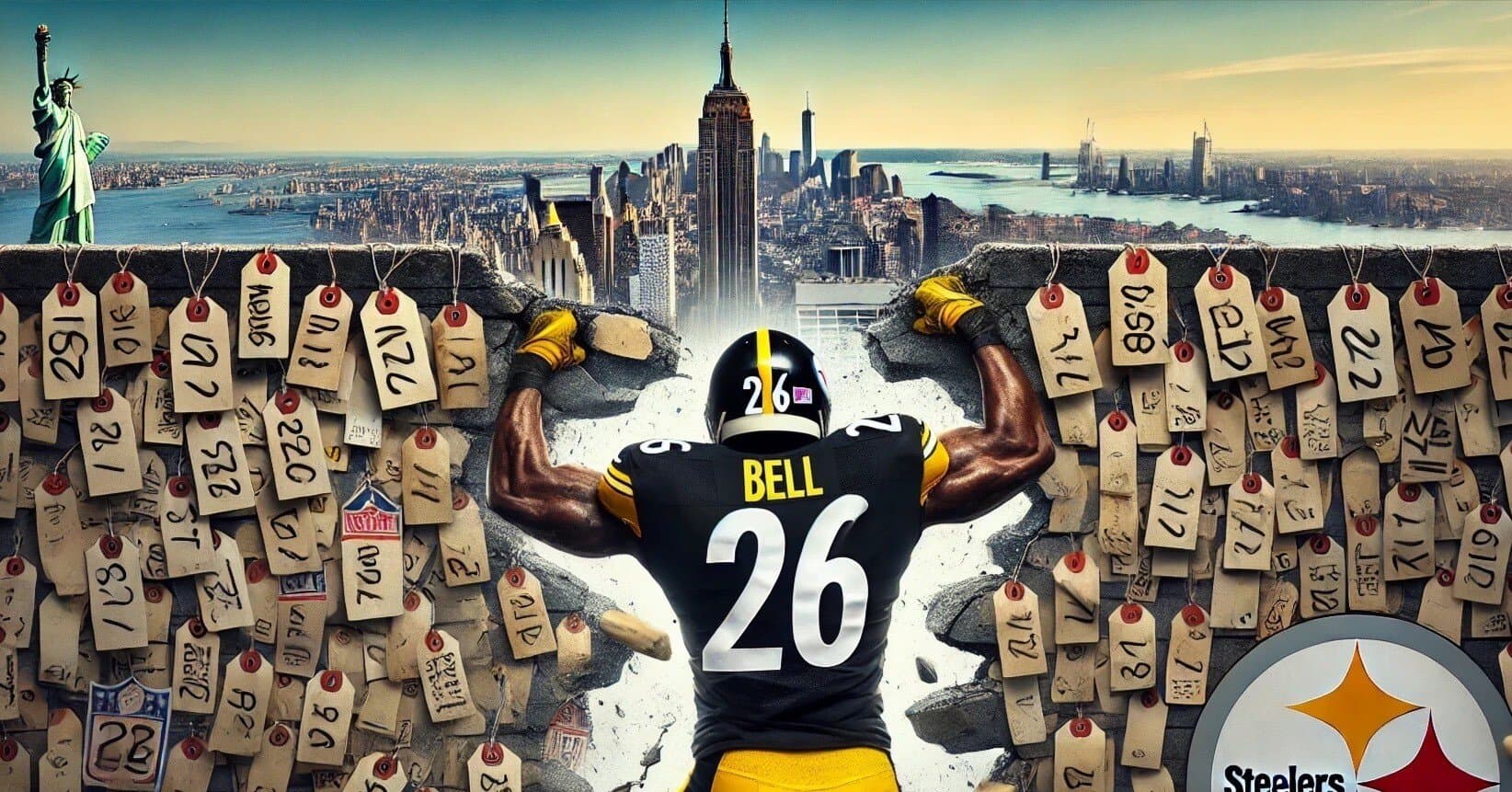
Part 1 covered the franchise tag as a useful tool for teams — the mechanics, the three reasons teams use it, and a breakdown of this year's notable tag decisions. Part 2 is about the other side: what the tag looks like from a player's perspective, how holdouts actually work in practice, and what specifically needs to change about the system.
The best way to read this: imagine you're Tee Higgins.
A player's frustration with being tagged rather than receiving a long-term extension:
4. Why Players Hate the Tag: They Want Length and Guarantees
If you've followed an NFL offseason, you've seen this play out — a tagged player announces he won't sign the tender, threatens to hold out, or skips voluntary workouts. Jessie Bates in Cincinnati, Josh Jacobs in Las Vegas, both dug in pretty hard in recent years. An increasing number of players are now negotiating no-tag clauses into their long-term extensions specifically to prevent this from happening again.
The no-tag clause gaining traction:
The reason players resist the tag is simple: it's a one-year deal. NFL careers are short, injury risk is constant, and performance can decline without warning — which means every player who's producing wants to lock in a long-term, heavily guaranteed contract before anything changes. Maximize the window while it's open.
The franchise tag doesn't give them that. Yes, the tag year is fully guaranteed. But beyond that single year? Nothing. And since teams can apply the tag up to three consecutive times, a player can technically spend three of their prime years on successive one-year deals with no long-term security, no ability to negotiate freely with other teams. Tee Higgins is living that reality now, going on two consecutive tags.
For the player, every tagged season is played under significant psychological pressure — perform even better than before, stay healthy, hope the team decides a long-term deal makes sense afterward. It's a grinding position to be in.
[Sidebar: The "I want more guarantees" situation isn't unique to tagged players]
Shortly after Myles Garrett requested a trade from Cleveland, he re-signed with the Browns within days. The "I want to compete for championships" framing made headlines, but the underlying driver was almost certainly simpler: his remaining contract had two years left, and the 2025 and 2026 base salaries were largely unguaranteed.
The standard structure on a five-year deal: years one and two are fully guaranteed at signing, year three becomes guaranteed if the player is on the roster through year two, years four and five are typically not guaranteed. If Garrett played out that contract and got injured or declined, Cleveland could walk away and his earning power would take a serious hit. The same logic explains why Saquon Barkley, Maxx Crosby, and — remarkably — Josh Allen (with four years remaining at the time) all extended early. In every case, the trigger was the near-term guarantee profile, not the overall length or total value.
Worth noting: early extensions aren't purely bad for teams. Lock a player in ahead of the annual cap increase and you get a market-rate deal relative to the year you signed it — which often looks like a bargain two years later. Yes, the team assumes more risk if performance declines. But if the player stays productive, the team wins on the deal.
5. Can Players Actually Refuse the Tag? The Holdout Playbook
So how much leverage does a tagged player actually have? Let's walk through the practical options — from least to most extreme — with real examples. (The "should / shouldn't" labels are personal opinions, treat accordingly.)
5.1. Announce Immediately That You Won't Play on the Tag and Request a Trade (March–May) → Do This
Davante Adams' immediate response to being tagged in 2022:
The first move: don't sign the tender right away. Publicly state that you won't play on the tag and formally request a trade. Signing too early eliminates some leverage and triggers practice participation obligations (with associated fine structures). Simply stating intent costs nothing and can move the needle — if front office anxiety increases, if public pressure builds, or if a trade inquiry comes in from another team, that's all upside.
Example: Davante Adams (2022, GB → LV)
- March 9: Tagged by Green Bay
- March 14: Informs the team he won't play on the tag
- March 18: Traded to Las Vegas on a five-year extension
That's an extraordinarily fast turnaround. To be fair, this probably wasn't purely a response to Adams pushing — it smells more like a tag-and-trade that was already in motion, with Green Bay wanting to move quickly for cap reasons. But the outcome is the best-case scenario regardless.
5.2. Skip Minicamp (May–June) → Do This
Saquon Barkley publicly announcing he'll miss minicamp:
Teams planning to use the tag as a one-year deal won't be particularly shaken by a player publicly stating he won't sign it. The next escalation step: skip the voluntary minicamp (roughly 10 sessions across May–June, with a mandatory three-day window).
If the player has already signed the tender, missing the mandatory portion triggers graduated fines ($17K, $34K, $51K by day). But even setting aside the fine structure, showing up for minicamp is a soft signal that you're not serious. Skipping it signals you mean it — which is pressure teams genuinely feel, because it delays installation of new schemes and puts established depth behind the learning curve.
Example: Saquon Barkley (2023, NYG)
Barkley had Schefter tweet that he was skipping for negotiation-related reasons — clean framing that generated sympathy without burning bridges. Effective. Unfortunately the July talks stalled anyway and he ended up playing the tag year. (Given that he then walked to Philly the following spring, in retrospect it probably worked out fine.)
5.3. Press Hard Before the Franchise Tag Deadline (Through Mid-July) → Absolutely Do This
The Chris Jones / KC holdout that produced a long-term deal before the deadline:
The single most important date for a tagged player: the Franchise Tag Deadline, set in mid-July. Commonly misunderstood — this isn't the deadline to sign the tender. It's the deadline after which a tagged player can only sign a one-year contract for that season. Extension talks are legally closed after this point.
That makes it the player's last real point of leverage. Everything before this moment is negotiation with upside — everything after is mopping up. This is when you go all in: credibly threaten a full-season holdout, pursue all media and public-relations avenues, work every angle. Franchise front offices care about their image. Generate enough pressure and the calculation shifts.
Even then: if the team makes a real offer, take the meeting and consider taking the deal. The leverage comes from the credible threat, not the actual holdout.
Example: Chris Jones (2020, KC)
Jones had multiple local media pieces written in his corner, and made the full-season holdout threat feel serious enough that Kansas City blinked. On July 14th — one day before the deadline — he signed a 4-year, $85M extension. (Personal opinion: Jones almost certainly wasn't going to sit out the whole year regardless. His 2024 situation — signing moments before kickoff — suggests he understands where the line is. But you have to make them believe you might.) Drew Brees did the same thing in 2012 — deadline-eve drama, then resolution. That's the pattern to understand.
As for how Jones's career went: all Pro multiple times during that extension window. Zero regrets on the deal from either side.
5.4. Continue Holding Out Through Training Camp and Preseason (Late July–Early November) → Probably Not Worth It on a Tag
The Le'Veon Bell holdout — the template for what prolonged tag resistance looks like:
If mid-July passes without a deal, everything changes. The legal ability to sign a long-term extension is gone. That was the entire purpose of the holdout — and it's now off the table.
What's left as upside from continuing the holdout:
- Increase trade pressure — signals that the "tag him again next year" path won't work, which can prompt the team to find a trade partner rather than repeat the cycle
- Avoid preseason injury risk
Against that:
- Enormous fine exposure if the player has already signed the tender
- No path to long-term security — the entire original objective is gone
- Lost conditioning time that typically shows up in performance
My honest assessment: if I were a player or agent, I'd cap the holdout at the mid-July franchise tag deadline. The post-deadline math just doesn't work in the player's favor. (The calculus is different for a non-tag extension holdout — players have gotten into early-August camp territory on those and come out okay. But that's a different situation.)
Example (trade achieved): Jadeveon Clowney (2019, HOU → SEA)
Clowney refused to sign and skipped the entire camp. An exhausted Houston front office eventually attempted a trade in late August — but because the extension deadline had passed, SEA was acquiring him purely as a one-year rental. The resulting trade landed two anonymous players and a third-round pick, with Houston absorbing 70% of his salary — for a three-time Pro Bowler. Clowney underperformed, likely due in part to missed camp time, and spent the next several years as a journeyman. JAX's Yannick Ngakoue followed nearly the identical path in 2020.
Example (eventual return): Jessie Bates (2022, CIN), Josh Jacobs (2023, LV)
The more common outcome: hold out through most of camp, sign right before the regular season opens, play the tag year, hit free agency the following year. Both players eventually landed long-term deals elsewhere, so the narrative looks okay in retrospect. But both situations came with conditioning lag, performance questions, and — in principle — no guarantee that the next year's situation would be any different. (If Higgins gets tagged again in 2026, Bates and Jacobs won't look like a model to follow.)
5.5. Sit Out the Regular Season (September Onward) → Almost Never Worth It
Le'Veon Bell's full-season holdout — the most extreme case on record:
This is where it gets genuinely brutal. No long-term deal possible. Camp is over. The relationship with the team has had months to deteriorate. The hard tag signing deadline falls around Week 10 (early November) — miss it and the season is completely gone. And without a signed contract, the player earns nothing.
Two players in franchise tag history actually went all the way to this outcome. Le'Veon Bell is the one people remember.
Example 1: Le'Veon Bell (RB, PIT, 2018)
Bell had two All-Pro selections on his rookie deal, then played the first tag year (2017) on the franchise tender — 400+ touches, First Team All-Pro, delivered everything asked. In 2018, Pittsburgh tagged him again. He walked away from the season entirely.
The following year, Bell signed with the Jets: 4 years, $52M ($35M guaranteed). The long-term deal he'd been holding out for — at figures reportedly not dramatically different from PIT's own offer. He never recaptured his form, was eventually released by the Jets, and barely featured again.
What the Bell holdout did accomplish: it happened to coincide with the broader elevation of the RB market. Devonta Freeman was the highest-paid running back in 2017 at $8.2M/year. Todd Gurley's extension changed that benchmark; Zeke Elliott and David Johnson continued the trend. If Bell had taken a low offer, the market might not have moved the same way. From the perspective of RBs as a class, he was arguably a martyr who benefited players who came after him.
Example 2: Sean Gilbert (DT, WAS, 1997)
Older and more obscure, but historically significant. Gilbert held out an entire season in 1997 rather than play on his tag — and Washington called the bluff, tagging him again in 1998. Since his tag was non-exclusive, Gilbert was able to negotiate with other teams. Carolina came in with the largest contract ever given to a defensive player at the time: 7 years, $46M. Washington didn't match, Gilbert went to Carolina, and Washington received two first-round picks in compensation. That deal is documented here.
He's the only player in NFL history to actually be poached by another team under a non-exclusive franchise tag. Had a quiet but functional four-year stint with Carolina. Better outcome than Bell. But again: the team that benefited most was Washington, pocketing two first-round picks.
Both cases illustrate the same underlying pattern: the team comes out ahead. The franchise tag salary is structured as base salary — no signing bonus, no guaranteed money if the player doesn't play. A holdout doesn't cost the team financially, and if the player's production was replaceable (James Conner seamlessly stepped in for Bell), there's barely any football cost either.
Bell showed up in my research as a loophole that inadvertently lifted the RB market. Gilbert got two first-round picks extracted for Washington. Extreme holdouts tend to benefit the teams more than the players.
Bell's final Pittsburgh season (2018) in context:
5.6. Summary: There Is No Real Veto on the Franchise Tag
The honest conclusion from all of the above: under the current system, players can use holdout tactics as leverage, but the decision ultimately belongs to the team. If a team refuses to extend and refuses to trade, a player's options reduce to:
- Sign the tag and play the one-year deal
- Refuse to sign and lose the entire season
Neither option involves negotiating freely with another team. And the second option, as Bell demonstrated, tends to hurt the player more than the team.
The Bell effect was real in another way: since his 2018 holdout, regular-season tag-related holdouts have essentially disappeared from the league. Players hold out through camp, through minicamp, through the July deadline push — but once the season starts? Everyone signs.
In practice, this means a tagged player who plays hardball through all the proper milestones and still doesn't get a deal will almost certainly end up playing the tag year — then potentially facing a second tag the following February. The leverage ceiling is lower than it looks from the outside.
6. What's Actually Broken About the Franchise Tag
Now that we've established the player-side dynamics: here are the five specific problems with the system as it exists, and what I'd change.
Starting point: the tag was introduced as a mechanism for teams to "protect their most valuable players." The use cases where it functions as a convenient one-year deal or a "let's evaluate him for another year" bridge — common among running backs and tight ends — are not what the system was designed for, and shouldn't be how it operates.
6.1. It's Called "Non-Exclusive" But Functions as a Monopoly
The rarity of another team actually bidding on a tagged player:
The non-exclusive franchise tag has been used to actually acquire a player from another team exactly once in 30 years — Sean Gilbert in 1998. The premise that a tagged player can negotiate freely with other teams simply doesn't hold in practice.
The structural reason: two first-round picks is a wildly oversized and blunt price. A top-five overall pick and the 32nd overall pick are treated identically. Teams that have cap space and genuine interest in a tagged player are typically rebuilding — meaning they hold early picks, and spending a top-10 first on a one-year rental (with no extension possible until July) is a nonstarter.
If no team was willing to give two firsts for Lamar Jackson — Lamar Jackson — the mechanism is functionally inert. The right-of-first-refusal match system already protects the original team; the compensation demand doesn't need to be this high.
Proposed fix: Consolidate to a single tag type, or if the non-exclusive structure stays, meaningfully reduce the compensation to something teams might actually pay.
6.2. Sequential Tagging Should Not Exist
The data on what happens when a player is tagged two consecutive years:
Given the original intent of the franchise tag, allowing a team to apply it in consecutive years makes very little sense. The implied logic of the system is: "You have one year to either sign your player long-term or accept that he's going to move on." Back-to-back and even three-year tagging defeats that.
There's been real discussion about this this year, and it resonates. The 20% salary increase for a second consecutive tag is supposed to be a deterrent — but clearly it's not steep enough, given that 13 players have faced consecutive tags since 2011.
Proposed fix: Ban consecutive tagging outright. If that's too restrictive, set the second-tag salary at 140% of the first — high enough that teams only do it in genuinely extraordinary circumstances.
6.3. Long-Term Contracts Can Only Be Signed Through Mid-July
The mid-July franchise tag deadline creates a structural problem:
Here's the contradiction at the center of the tag: it's explicitly designed to facilitate long-term extension talks — but those talks legally have to conclude by mid-July, before training camp begins. After that date, the player is locked into a one-year deal regardless of what either side wants.
As covered in section 5.3, this means the most powerful holdout tool in normal extension negotiations — holding out of camp until a deal is reached — is literally not available to tagged players. On a standard extension, you can push into early August and still get a long-term deal. On a franchise tag, you can't. That asymmetry isn't fair.
Proposed fix: Remove the long-term contract deadline entirely. If a deadline must exist, push it to at least the eve of Week 1 or the trade deadline — giving both sides more time to negotiate with real pressure. Alternatively, requiring a portion of the tag salary to be paid upfront as a signing bonus would give teams a financial incentive to resolve things faster.
6.4. The Position Groupings Are Messy
The position grouping breakdown showing LB inflation and other imbalances:
Splitting tag values by position makes sense in principle, but the current groupings create real distortions. The most obvious: LB salaries are significantly inflated because most of the best pass rushers in the league are classified as outside linebackers (TJ Watt being the clearest example). This means the LB top-five is dominated by edge rushers, while DE — as a separate bucket — gets underpopulated. The practical result: tagging an interior linebacker would currently require paying more than Roquan Smith earns.
Meanwhile, OL is treated as a single undifferentiated pool across all five positions — tackles, guards, centers all compute from the same list — even though tackle salaries have diverged significantly from interior OL.
The Trey Smith (KC) situation this year is the OL distortion playing out in real time: use the guard tag and suddenly you've matched the highest guard salary in the league.
Position-specific tag salary issues in more detail:
Proposed fix: Base position classification on where the player actually lines up the most snaps. Separate IOL from OT, ILB from OLB, and create a unified "Edge" bucket combining DE and OLB.
6.5. Every Position Uses the Same "Top-5 Average" Formula
Related to the grouping issue, but distinct: every position computes its tag using the same top-5 salary average, regardless of how many players at that position contribute meaningfully on a roster or across the league.
OL fields five starters per team. WR twos are genuine contributors who command significant contracts. But running backs and tight ends typically have one primary starter per team — and "top five in the league" for those positions doesn't reflect the true market rate for an elite player at that spot the way it does for WR or OL.
(Side note: how often do two Pro Bowl RBs share a backfield? Alvin Kamara and Mark Ingram in 2017 Saints is essentially the only example I can think of. I just wanted to say that out loud.)
The result: RB and TE tags chronically undervalue elite players at those positions, which is why they get used as one-year convenience contracts so often. The OL dynamic runs the other way — five starters per team from a combined pool inflates the tag number in ways that create the Trey Smith situation.
Proposed fix: Scale the number of salaries used in the average by positional prevalence. Use top-3 for RB and TE, top-5 for WR, top-7 or top-8 for the full OL pool. Make the formula reflect actual positional scarcity.
7. Final Thoughts
Five specific problems, five proposed changes. The overarching theme: the franchise tag system is structurally weighted toward team owners in ways that are unusual even by comparison to other professional sports leagues. Given that the modern NFL has moved strongly toward early extensions and proactive roster management, there's a real argument that the tag has largely outlived the purpose it was designed to serve.
Players should be able to have their value recognized and have meaningful agency over where they play. The tag, in its current form, stands in the way of both. Reform is overdue.
Thanks for reading a long one.