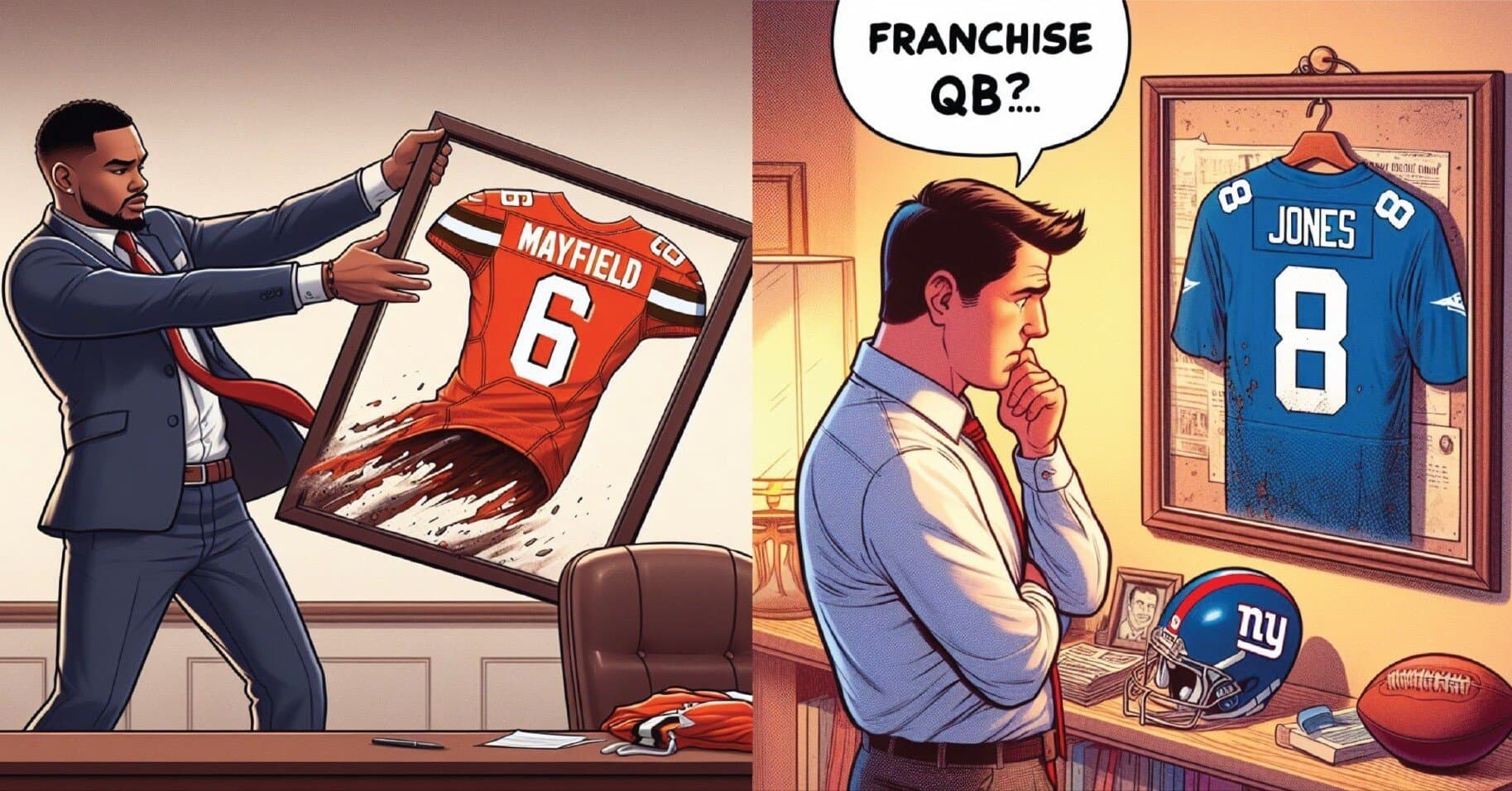
If Part 1 of this series was about the fifth-year option at its best — a team-friendly mechanism to lock in a franchise quarterback on the cheap — Part 2 is about the landmines. Because for every Patrick Mahomes extension that the fifth-year option helped set up perfectly, there's a Baker Mayfield situation lurking around the corner.
The 2021 CBA amendment made the fifth-year option significantly more consequential. What used to be a relatively low-risk tool is now one of the most consequential decisions a general manager makes after a quarterback's third year. Let's walk through three cases that illustrate exactly why.
1. The 2021 Rule Change
The fifth-year option was first introduced in the 2011 CBA. When the league and the NFLPA agreed to a new CBA in 2020 (running through 2030), two significant changes were made.
1.1. Change 1: From Injury Guarantee to Fully Guaranteed
Under the old rules, exercising the fifth-year option only guaranteed the salary in the event of injury — meaning a team could cut the player before the fifth year started and owe nothing if he was healthy. That created a dynamic like this:
Exercise option after Year 3
→ Player struggles in Year 4
→ Release before Year 5 starts (no dead money since salary wasn't guaranteed)
Several teams used this exit hatch. Under the new CBA, the fifth-year salary is fully guaranteed at the time of exercise. That changes the calculus entirely.
 Leonard Floyd (now with Buffalo) is a pre-2021 example: his fifth-year option was exercised, then he was cut before the year began (via Spotrac)
1.2. Change 2: Salary Now Based on Performance, Not Draft Slot
The old system tied the fifth-year salary to draft position regardless of what the player had actually done:
- Picks 1–10: Average of the top 10 at the position (same as the transition tag)
- Picks 11–32: Average of the 3rd through 25th highest at the position
The result was absurd: in the 2017 draft class, Solomon Thomas (No. 3 overall) had a higher fifth-year number than T.J. Watt (No. 30 overall) — $15M vs. $10M. Thomas's option was never going to be picked up. The new system uses snap counts and Pro Bowl selections from the first three years to determine the salary tier, which at least connects the number to actual production.
1.3. Why This Made Life Harder for GMs
The changes kicked in for the 2021 exercise cycle (2018 first-round picks). The full-guarantee requirement is the real game-changer — it turned the option from a reversible commitment into a binding one. To understand the stakes, let's look at three quarterbacks drafted in consecutive years.
- 2018 Draft, No. 1 overall: Baker Mayfield (CLE → CAR → LAR → TB)
- 2019 Draft, No. 6 overall: Daniel Jones (NYG)
- 2020 Draft, No. 26 overall: Jordan Love (GB)
2. Case Study 1: Baker Mayfield (Year 3 success, Year 4 collapse)
2.1. A Playoff Run Seals the Option
Mayfield entered the league with enormous hype and backed it up in Year 3. After going 6-7 and 6-10 in his first two seasons, he led Cleveland to an 11-5 record, a Wild Card win over Pittsburgh, and a Divisional round appearance against Kansas City. He looked like the real deal.
Mayfield's Year 3 playoff performance
Yes, Nick Chubb and Kareem Hunt were doing heavy lifting, but nobody was questioning Mayfield's franchise-quarterback status at that point. Cleveland exercised the fifth-year option. Of course they did.
2.2. Year 4 Falls Apart
Then 2021 happened. Mayfield posted career-worst numbers across the board. The Browns finished 8-9. Midway through the season, OBJ's father posted a video on Instagram criticizing Mayfield for missing open receivers — Odell Beckham Jr. was released the same week. Mayfield ended up on injured reserve after the team was eliminated from playoff contention.
OBJ's father posts his controversial video; OBJ is released the same week
2.3. The Watson Trade Changes Everything
Cleveland's response was decisive. The front office decided Mayfield wasn't their franchise quarterback and went all-in on acquiring Deshaun Watson. Mayfield — who had already requested a trade once Cleveland started interviewing Watson — made the split official. There was no coming back from this.
Cleveland outbid New Orleans and Atlanta for Watson's services, offering a fully guaranteed deal that gave him no incentive to veto the trade.
The Watson trade to Cleveland is finalized
2.4. The Fully Guaranteed Trap
Now Cleveland had a problem. Mayfield wasn't going to stick around as a backup. That left two options: trade him or release him.
Under the old CBA rules, releasing Mayfield before his fifth year started would have cost Cleveland nothing. Under the new rules, his $18.5M fifth-year salary was fully guaranteed the moment the option was exercised. Releasing him would mean paying $18.5M for a player no longer on the roster. As I wrote in my dead money piece, you can cut someone with a fully guaranteed salary, but the cap hit doesn't go away — you just lose the roster spot too. The release option was effectively off the table.
2.5. Trading from a Position of Weakness
That left a trade. But as any negotiator knows, when your leverage is zero, the price suffers. Every team in the league knew Cleveland couldn't keep Mayfield, couldn't release him cleanly, and was desperate to move on.
The Mayfield trade to Carolina is reported
Cleveland eventually dealt Mayfield to Carolina in July for a fifth-round pick (with a fourth-round escalator if he played 70% of snaps). Cleveland also ate $10.5M of his $18.5M salary. For context: the prior year, Carolina acquired Sam Darnold — a player with objectively worse numbers than Mayfield — for a sixth-round pick, a future second, and a future fourth. The fully guaranteed fifth year had done its damage. When you exercise a quarterback's fifth-year option and he regresses, you're not just stuck with a bad player — you're stuck in a bad negotiating position too.
2.6. What Cleveland Should Have Done
Pursuing Watson made sense given his talent level. But Cleveland made one avoidable mistake: they should have included Mayfield in the Watson trade package. When the Rams traded for Matthew Stafford and the Seahawks traded for Russell Wilson, the incumbent starting quarterback — Jared Goff and Drew Lock, respectively — was included in the deal going back. Both teams understood that once the new starter was in place, the trade value of the old one would crater.
Houston reportedly didn't want Mayfield, partly because they genuinely believed Davis Mills was their franchise quarterback. But Cleveland was negotiating from a position of relative strength in that moment — Watson had just agreed to come — and they should have pushed harder. Once the deal closed, the leverage was gone.
3. Case Study 2: Daniel Jones (Year 3 failure, Year 4 breakout)
A month after the Mayfield situation played out, New York declined Daniel Jones's fifth-year option.
NYG announces it will not exercise Daniel Jones's fifth-year option
3.1. Three Years of Mediocrity
The decision was easy to understand in hindsight. Jones had shown flashes — he took over from Eli Manning midway through his rookie year and posted solid numbers (3,000 yards, 24 TDs, 12 INTs) — but never broke through. Three years, 12 wins, 25 losses. His fifth-year number was $22.4M fully guaranteed. That's a lot of commitment for a player who hadn't proven he belonged in that tier.
A memorably costly Jones play from Year 3
3.2. Year 4 Changes the Conversation
Then New York hired Brian Daboll. Jones added a rushing dimension (700 yards on the ground), the Giants won more than they lost, and New York won a playoff game. Suddenly, the player everyone had written off looked like a legitimate starter — just like Mayfield in Year 3.
Jones's Year 4 playoff performance
3.3. The Franchise Tag Problem
Here's where declining the option backfires. Because the Giants hadn't exercised the fifth-year option, Jones's rookie deal was expiring. To keep him from hitting free agency, New York had to use the franchise tag — a one-year, non-exclusive tender worth $32.4M.
The catch: you can only franchise tag one player per year. Saquon Barkley had also bounced back in 2022 and was also approaching free agency. The Giants were now in a position where they had to choose between franchising their starting quarterback or their Pro Bowl running back. Both were critical. Only one could be tagged.
3.4. Signing Jones to an Extension
As the tag deadline approached, New York made its call:
Daniel Jones: 4-year, $160M extension
Saquon Barkley: Franchise tag ($10M)
Jones's extension and Barkley's franchise tag are reported
The Jones contract was immediately criticized as an overpay, and given how New York's 2023 season went, that criticism looks valid. But there's another way to read it: Jones's agent executed a near-perfect negotiation. With a hard deadline looming and the franchise tag already committed to Barkley, the Giants had no leverage. The final number reflects that.
3.5. What Would Have Happened With the Option
If New York had exercised the fifth-year option after Year 3 — when Jones had done nothing to earn it — the entire dynamic shifts. They could have evaluated him in Year 4 with the option in place, used the franchise tag on Barkley without any drama, and negotiated Jones's extension at their own pace, with real leverage.
That was the right call at the time, even in hindsight. Three years of unremarkable play under the new fully-guaranteed rules doesn't justify the commitment. The lesson isn't that New York was wrong to decline — it's that in the NFL, a player can look like a bust in Year 3 and a starter worth $160M in Year 4, and there's almost no way to predict which version you'll get.
4. Case Study 3: Jordan Love (Barely Played in Years 1–3)
If the Mayfield and Jones cases represent the two obvious failure modes — exercise and regret, decline and regret — the Packers found a third path with Jordan Love.
Baker Mayfield: Exercised after Year 3 → regretted after Year 4 decline
Daniel Jones: Declined after Year 3 → regretted after Year 4 breakout
4.1. A Quarterback Without a Track Record
Love's situation was unique. Green Bay drafted him in the first round in 2020, then kept him on the bench for three years while Aaron Rodgers continued to play at an MVP level. When it came time to make the fifth-year option decision — after Year 3, with almost no starting experience — the Packers were essentially being asked to fully guarantee $20M for a player they'd never seen start an NFL game.
(Yes, Aaron Rodgers also sat for three years. But Rodgers signed before the rookie wage scale existed; he had a five-year deal from the start, so the team had more runway to evaluate him. Love's contract structure is fundamentally different.)
The fifth-year option deadline approaching for Love
Exercising the option at $20M fully guaranteed felt like a significant gamble given the complete absence of starting-quarterback data. Most observers expected Green Bay to decline — and the scenarios weren't appealing either way:
- Decline → Love struggles in Year 4 → new QB search begins
- Decline → Love succeeds in Year 4 → scramble for a contract or use the franchise tag
4.2. Option C: Just Sign an Extension
The Packers found a different answer entirely.
Green Bay bypasses the fifth-year option and signs Love to a direct extension
With the May 2 deadline approaching, Green Bay announced they were skipping the option discussion entirely and signing Love to a one-year extension worth $13.5M fully guaranteed, with incentives that could push it to $22.5M.
Here's why it worked for both sides:
- For the Packers: Under the fifth-year option, they'd owe $20M fully guaranteed. Under this deal, the guaranteed commitment drops to $13.5M. If Love fails as a starter, the downside is smaller. They also extended the runway by a year, giving more time to evaluate or negotiate a longer deal.
- For Love: He gets less guaranteed money than the option would have provided, but getting cut and hitting free agency with no starting experience is a far worse outcome. And if he hits the incentive thresholds, he actually earns more than the option number.
Neither side got their best-case scenario, but both avoided their worst one. In a situation where the normal binary — exercise or decline — both carried serious risk, the Packers found a middle path that distributed the uncertainty more evenly. For all the criticism Green Bay draws for drafting Love in the first place, the way they structured his fifth year was genuinely creative.
5. Conclusion
The fifth-year option is a powerful tool — but only under the right circumstances.
- For quarterbacks who've proven they're franchise starters, it's exactly what it's designed to be: a cost-controlled extension year that buys time before the big long-term deal. (That's the subject of Part 1.)
- For quarterbacks still proving themselves, it's a minefield. Exercise it and you're fully exposed if they regress. Decline it and you're scrambling if they break out. The 2021 rule change made both outcomes more painful.
NFL fans spend a lot of energy criticizing their team's front office. And sometimes those criticisms are fair. But the fifth-year option decisions we've walked through here — decisions made after three years of data, with millions of dollars and years of roster construction on the line, under a deadline — are genuinely hard. Reasonable general managers made defensible calls and ended up on the wrong side of history.
That's the job. And it's harder than it looks.